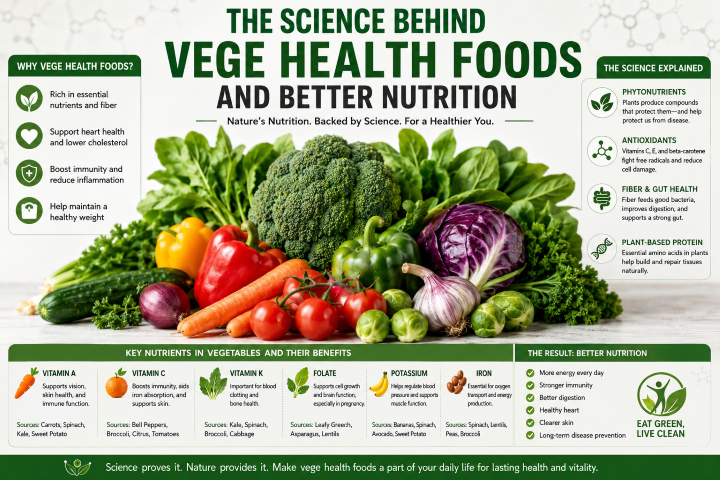
Walk into any grocery store today and you’ll notice something: the produce section has expanded, plant-based labels are everywhere, and “eat more vegetables” has become one of the most repeated pieces of health advice in modern history. But behind the trend lies decades of nutritional science that explains exactly why vegetables and vegetable-derived health foods do so much for the human body.
This isn’t about following a diet fad. It’s about understanding the biochemistry, physiology, and clinical evidence that make vegetables one of the most powerful tools we have for improving health outcomes — from heart disease and diabetes prevention to gut health, immunity, and even mental well-being.
Why Vegetables Matter: A Nutritional Overview
Vegetables are not just “low-calorie filler” on a plate. They are complex biological packages containing an intricate mix of macronutrients, micronutrients, fiber, water, and thousands of bioactive plant compounds known as phytochemicals. Unlike processed foods, which are often stripped of their natural nutrient matrix, vegetables deliver nutrients in a form the body has evolved to recognize and use efficiently.
At a basic level, vegetables provide:
- Vitamins (A, C, K, folate, and various B vitamins)
- Minerals (potassium, magnesium, iron, calcium)
- Dietary fiber (both soluble and insoluble)
- Water (many vegetables are 80–95% water by weight)
- Phytochemicals (polyphenols, carotenoids, glucosinolates, flavonoids)
- Low energy density (fewer calories per gram compared to processed foods)
This combination is what nutritional scientists refer to as “nutrient density” — the amount of beneficial nutrients you get relative to the calories consumed. Leafy greens, cruciferous vegetables, and colorful root vegetables consistently rank among the most nutrient-dense foods on the planet.
The Role of Phytonutrients: Nature’s Chemical Defense System
One of the most fascinating areas of modern nutrition research involves phytonutrients — the natural compounds vegetables produce to protect themselves from UV radiation, pests, and environmental stress. When humans consume these compounds, many of them appear to confer protective benefits to us as well.
Carotenoids
Found in orange, yellow, and dark green vegetables (carrots, sweet potatoes, spinach, kale), carotenoids like beta-carotene, lutein, and zeaxanthin function as antioxidants. Beta-carotene converts into vitamin A in the body, supporting vision, immune function, and skin health. Lutein and zeaxanthin accumulate specifically in the retina, where research links them to reduced risk of age-related macular degeneration.
Glucosinolates
Cruciferous vegetables — broccoli, cauliflower, Brussels sprouts, cabbage, kale — contain sulfur-based compounds called glucosinolates. When these vegetables are chopped or chewed, an enzyme called myrosinase converts glucosinolates into isothiocyanates, including a well-studied compound called sulforaphane. Laboratory and epidemiological research has associated sulforaphane with the activation of detoxification enzymes in the liver and potential anti-inflammatory effects.
Polyphenols and Flavonoids
Found in a wide range of vegetables (as well as fruits, tea, and cocoa), polyphenols are among the most studied plant compounds in nutritional science. Flavonoids, a major subclass, have been linked in research to improved blood vessel function, reduced oxidative stress, and modulation of inflammatory pathways. Onions, peppers, and purple vegetables like eggplant are particularly rich sources.
Nitrates
Leafy greens such as spinach, arugula, and beet greens contain dietary nitrates, which the body converts into nitric oxide. Nitric oxide plays a role in vasodilation — the widening of blood vessels — which has been studied for its potential to support healthy blood pressure and exercise performance.
Fiber: The Underrated Superstar of Vegetable Nutrition
If phytonutrients are the “specialists” of vegetable nutrition, fiber is the workhorse. Dietary fiber is arguably the single most consistently supported nutritional factor linked to long-term health outcomes across large population studies.
Vegetables contain two primary types of fiber:
- Soluble fiber — dissolves in water to form a gel-like substance in the digestive tract. It has been shown to slow digestion, moderate blood sugar spikes after meals, and bind to cholesterol particles, potentially aiding in their excretion.
- Insoluble fiber — adds bulk to stool and supports regular bowel movements by speeding the passage of food through the digestive system.
Beyond digestion, fiber plays a critical role in a process that has become a major focus of modern nutrition science: feeding the gut microbiome.
Vegetables and the Gut Microbiome
The human gut hosts trillions of microorganisms that influence digestion, immune regulation, and even mood. Emerging research over the past two decades has repeatedly pointed to dietary fiber — particularly the fermentable fiber found in vegetables — as one of the primary fuel sources for beneficial gut bacteria.
When gut bacteria ferment fiber, they produce short-chain fatty acids (SCFAs) such as butyrate, acetate, and propionate. These compounds:
- Serve as an energy source for cells lining the colon
- Help maintain the integrity of the gut barrier
- Are associated in research with reduced systemic inflammation
- May play a role in regulating appetite and metabolic signaling
A diverse vegetable intake — meaning many different types and colors of vegetables — has been associated with greater microbial diversity, which researchers increasingly view as a marker of gut health. This is one of the key scientific arguments behind the “eat the rainbow” recommendation: different pigments and fiber structures feed different bacterial populations.
Vegetables and Chronic Disease Prevention
Large-scale epidemiological studies conducted over decades have consistently found associations between higher vegetable consumption and reduced risk of several chronic diseases.
Cardiovascular Health
Population studies, including long-running cohort research, have linked higher vegetable intake with lower rates of cardiovascular disease. Proposed mechanisms include:
- Potassium content, which may help counterbalance sodium’s effect on blood pressure
- Fiber’s role in modestly lowering LDL cholesterol
- Nitrates supporting vascular function
- Antioxidant compounds potentially reducing oxidative damage to blood vessels
Type 2 Diabetes and Blood Sugar Regulation
Non-starchy vegetables have a low glycemic load, meaning they cause minimal spikes in blood glucose. Fiber slows the absorption of sugar into the bloodstream, and some research suggests that regular vegetable consumption is associated with improved insulin sensitivity over time. Replacing refined carbohydrates with vegetables in meals is a strategy frequently recommended by dietitians for blood sugar management.
Cancer Risk Reduction
Certain vegetable compounds, particularly the glucosinolates in cruciferous vegetables, have been studied for their potential role in cellular detoxification pathways. While no single food prevents cancer, dietary patterns high in vegetables have been associated in observational research with reduced risk for several cancer types, likely due to a combination of fiber, antioxidants, and reduced intake of processed foods that typically accompanies vegetable-forward diets.
Weight Management
Because vegetables are low in energy density but high in volume and fiber, they promote satiety — the feeling of fullness — without contributing excess calories. This makes them a practical tool for weight management, allowing people to eat satisfying portions while maintaining a calorie balance appropriate for their goals.
The Science of “Vege Health Foods”: Beyond Raw Vegetables
The term vege health foods often refers not just to raw vegetables, but to a broader category of plant-derived health products: vegetable powders, fermented vegetable foods, cold-pressed vegetable juices, plant-based protein blends, and functional foods formulated around vegetable extracts. Understanding the science here requires a slightly different lens.
Fermented Vegetable Foods
Foods like sauerkraut, kimchi, and fermented pickles undergo lacto-fermentation, a process in which bacteria convert sugars into lactic acid. This process:
- Introduces live probiotic bacteria into the digestive tract (in unpasteurized versions)
- Increases the bioavailability of certain nutrients
- Produces additional beneficial compounds not present in the raw vegetable
Research on fermented foods and the gut microbiome is a growing field, with some studies suggesting regular consumption may support microbial diversity and immune regulation.
Vegetable Powders and Extracts
Dehydrated vegetable powders (such as spirulina, wheatgrass, or vegetable blends) concentrate certain nutrients but come with an important scientific caveat: processing can degrade heat-sensitive vitamins like vitamin C, and fiber content is often significantly reduced compared to whole vegetables. These products can be a convenient supplement to a diet but are generally not a full substitute for whole-food vegetables, particularly regarding fiber intake and the gut microbiome benefits discussed earlier.
Cold-Pressed Juices
Juicing removes most of the insoluble fiber from vegetables while retaining vitamins, minerals, and many phytonutrients. This means juices can deliver a concentrated dose of certain micronutrients, but nutrition scientists generally note that the loss of fiber changes how the body processes the remaining sugars and nutrients — often resulting in faster absorption and less of the fiber-related benefits like satiety and blood sugar regulation.
How Cooking Affects Vegetable Nutrition
A common question in nutritional science is whether raw or cooked vegetables are “better.” The honest, evidence-based answer is: it depends on the nutrient and the vegetable.
- Cooking increases bioavailability of some nutrients. For example, cooking tomatoes increases the availability of lycopene, a carotenoid linked to antioxidant activity. Similarly, cooking carrots can increase beta-carotene absorption.
- Cooking decreases some nutrients. Water-soluble vitamins like vitamin C and certain B vitamins can degrade with heat or leach into cooking water.
- Different cooking methods matter. Steaming tends to preserve more nutrients than boiling, since boiling causes water-soluble vitamins to leach out into the water. Roasting and sautéing generally fall in between.
The practical takeaway from nutrition science is variety: eating a mix of raw and cooked vegetables, prepared in different ways, maximizes the range of nutrients absorbed over time.
Micronutrient Synergy: Why Whole Foods Outperform Isolated Supplements
One of the more nuanced findings in nutrition research is that nutrients often work better in combination than in isolation. This is sometimes called the “food matrix effect” or nutrient synergy.
For example:
- Vitamin C enhances the absorption of non-heme iron found in plant foods when eaten together (such as spinach with citrus).
- Fat-soluble vitamins and carotenoids (like beta-carotene) are better absorbed when consumed alongside a source of dietary fat, which is why a drizzle of olive oil on a vegetable salad isn’t just for flavor — it improves nutrient uptake.
- Fiber slows sugar absorption in a way that isolated fiber supplements don’t always replicate as effectively, likely due to the complex physical structure of whole vegetables.
Large clinical trials testing isolated antioxidant supplements (such as beta-carotene or vitamin E pills) have generally failed to replicate the health benefits seen in populations that eat whole vegetables. This is one of the strongest scientific arguments for prioritizing whole vege health foods over isolated supplements: the benefits appear to come from the combination of compounds working together, not any single nutrient acting alone.
Vegetables and Inflammation
Chronic low-grade inflammation is increasingly recognized by researchers as an underlying factor in many long-term health conditions, including cardiovascular disease, type 2 diabetes, and certain autoimmune conditions. Vegetables are a central component of anti-inflammatory dietary patterns studied in nutrition science, such as the Mediterranean diet.
The proposed mechanisms include:
- Antioxidant compounds neutralizing free radicals that can trigger inflammatory responses
- Fiber-derived short-chain fatty acids modulating immune cell activity in the gut
- Reduced intake of pro-inflammatory processed foods when vegetables replace them in the diet
While research on specific anti-inflammatory foods is still evolving, dietary patterns rich in vegetables consistently show favorable associations with lower markers of systemic inflammation in observational studies.
The Gut-Brain Connection: Vegetables and Mental Well-Being
An emerging and increasingly popular area of research is the gut-brain axis — the communication network between the digestive system and the brain. Since a significant portion of the body’s serotonin is produced in the gut, and gut bacteria appear to influence neurotransmitter activity, researchers have begun exploring how diet — particularly fiber and fermented vegetable intake — might relate to mood and cognitive function.
Some observational studies have found associations between vegetable-rich diets and lower rates of reported depressive symptoms, though researchers are careful to note that correlation doesn’t prove causation, and diet is just one of many factors influencing mental health. Still, the biological plausibility — supported by the role of SCFAs, reduced inflammation, and improved blood sugar stability — makes this a promising and active area of nutritional science.
Vegetables Across the Lifespan: Science for Every Age
The nutritional needs of the human body change over time, and research shows that vegetables play a distinct, evolving role at each life stage.
Childhood and Adolescence
Early exposure to a wide variety of vegetables has been linked in developmental research to more accepting food preferences later in life — a phenomenon sometimes called “flavor programming.” Because taste preferences begin forming even before birth (through amniotic fluid and later breast milk), repeated exposure to vegetables in early childhood appears to increase the likelihood of lifelong acceptance. Nutritionally, the fiber, folate, and micronutrients in vegetables support healthy growth, cognitive development, and immune system maturation during these formative years.
Adulthood
For adults, vegetable intake is closely tied to the prevention of the chronic diseases discussed earlier — cardiovascular disease, type 2 diabetes, and certain cancers. This is also the life stage where dietary patterns become most habitual, making it a critical window for establishing consistent vegetable-rich eating patterns that compound in benefit over decades.
Older Adulthood
As people age, muscle maintenance, bone density, and cognitive health become increasingly important. Vegetables contribute to this in several ways: vitamin K (found in leafy greens) plays a role in bone metabolism, potassium may help offset age-related bone mineral loss, and the anti-inflammatory properties of phytonutrients are of particular interest to researchers studying age-related cognitive decline. Additionally, the fiber in vegetables becomes especially important for digestive health, which can be a common concern in older populations.
Common Myths About Vege Health Foods, According to Research
As vegetables and plant-based health foods have grown in popularity, a number of misconceptions have emerged. Here’s what the science actually says about some of the most common ones.
- Myth: All vegetables are nutritionally equal: In reality, nutrient density varies dramatically. Leafy greens, cruciferous vegetables, and deeply colored vegetables (like beets and purple cabbage) tend to offer significantly more phytonutrients per calorie than starchy vegetables like potatoes or corn — though starchy vegetables still offer valuable fiber and micronutrients and have a place in a balanced diet.
- Myth: Frozen vegetables are nutritionally inferior to fresh: Research generally shows that frozen vegetables, which are typically flash-frozen shortly after harvest, can retain comparable — and in some cases higher — levels of certain nutrients compared to “fresh” vegetables that have spent days in transit and storage before reaching a plate. Freezing halts much of the nutrient degradation that begins as soon as a vegetable is harvested.
- Myth: You need to eat vegetables raw to get the most nutrients: As discussed earlier, this depends entirely on the nutrient and the vegetable. Some nutrients increase with cooking (like lycopene in tomatoes), while others decrease (like vitamin C). No single preparation method maximizes every nutrient simultaneously.
- Myth: Vegetable supplements can fully replace whole vegetables: Powders, pills, and extracts may offer concentrated doses of specific compounds, but they typically lack the fiber and the complex nutrient matrix that research increasingly shows is important for the synergistic benefits of whole-food consumption.
- Myth: Organic vegetables are always significantly more nutritious: Some studies have found modestly higher levels of certain antioxidants in organically grown produce, but the differences are generally small and inconsistent across research. The more consistently supported factor for health outcomes is simply total vegetable consumption, regardless of farming method.
The Role of Vegetables in Sustainable, Long-Term Eating Patterns
Nutrition science has increasingly moved away from evaluating single foods in isolation and toward studying overall dietary patterns — and vegetables are a consistent common denominator across nearly every eating pattern associated with positive long-term health outcomes in research, including the Mediterranean diet, the DASH diet (Dietary Approaches to Stop Hypertension), and various plant-forward dietary frameworks.
What these patterns share is not restriction, but emphasis: they build meals around vegetables, whole grains, legumes, and healthy fats, while naturally limiting ultra-processed foods, added sugars, and excess sodium simply because there’s less room for them on the plate. This pattern-based approach reflects an important scientific principle — health outcomes are shaped less by any single “superfood” and more by the cumulative, long-term composition of the diet as a whole.
Practical Ways to Apply the Science
Understanding the research is useful, but application matters more. Based on the science covered above, here are evidence-informed strategies for maximizing the benefits of vege health foods:
- Eat a wide variety of colors: Different pigments correspond to different phytonutrient profiles, so variety maximizes the range of compounds you consume.
- Don’t skip the fiber: Whole vegetables offer benefits that juices and powders often can’t fully replicate.
- Combine cooking methods: Mix raw and cooked vegetables throughout the week to capture nutrients that are better absorbed in each state.
- Add healthy fats: A small amount of olive oil, nuts, or avocado alongside vegetables can improve absorption of fat-soluble nutrients.
- Include fermented vegetables: Foods like sauerkraut or kimchi can support gut microbial diversity when added to meals.
- Prioritize whole foods over isolated supplements: The synergy of nutrients in whole vegetables generally outperforms single-nutrient pills in research.
- Build vegetables into every meal, not just as a side dish, to consistently reach recommended daily intake levels.
Conclusion
The science behind vege health foods is not a passing trend — it’s the result of decades of nutritional research spanning biochemistry, epidemiology, and clinical trials. Vegetables offer a unique combination of fiber, vitamins, minerals, and phytonutrients that work together in ways isolated supplements simply can’t replicate. From feeding a healthy gut microbiome to supporting cardiovascular health, regulating blood sugar, and potentially even influencing mood through the gut-brain axis, the evidence consistently points in one direction: a diverse, vegetable-rich diet is one of the most well-supported strategies for long-term health.
Whether it’s a handful of steamed broccoli, a bowl of fermented kimchi, or a colorful salad drizzled with olive oil, the science is clear — vegetables aren’t just good for you. They are, quite literally, some of the most biologically sophisticated foods on the planet, and modern nutrition research continues to reveal just how deeply their benefits run.