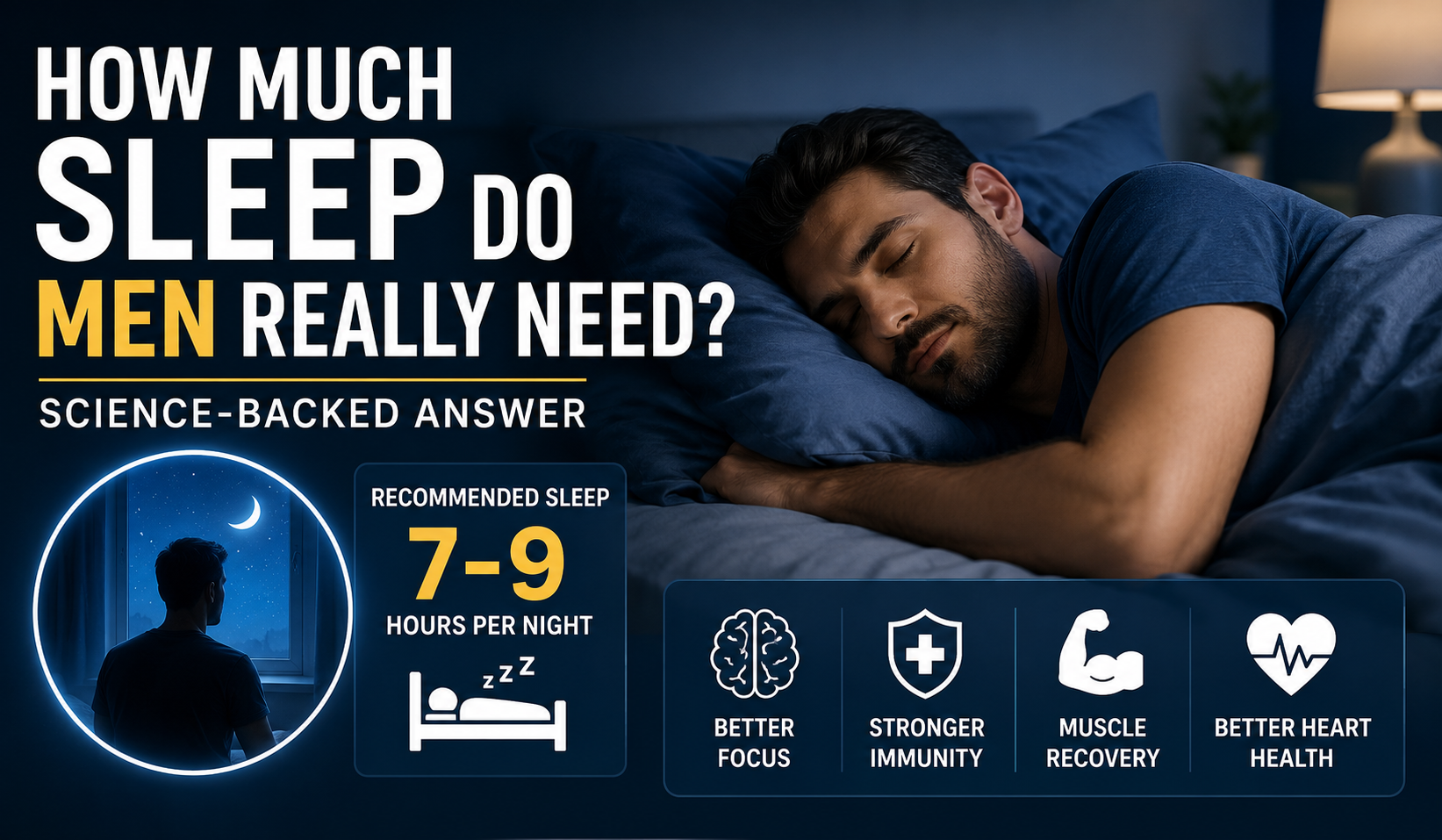
There’s a specific kind of pride a lot of men take in running on five hours of sleep — treating exhaustion like proof they’re working hard enough. Here’s the uncomfortable truth backed by research: that mindset isn’t just wrong, it’s actively working against you. Here’s what the science actually says about how much sleep men need, and why so many men are getting it wrong.
The Science-Backed Answer
According to the American Academy of Sleep Medicine and the Sleep Research Society, adults need 7 to 9 hours of sleep per night for optimal health. This recommendation is echoed consistently across major health institutions — the National Institutes of Health (NIH), Harvard Health, and the National Sleep Foundation all point to the same range.
One detail worth knowing: research consistently shows men and women need roughly the same amount of sleep. There’s no scientifically supported “men need less sleep” exception — that’s simply not how sleep biology works. If anything, some research suggests women may experience more frequent sleep disruptions due to hormonal factors, but the underlying need for 7-9 hours applies equally.
Why So Many Men Fall Short
Sleep specialists describe a common pattern among men: viewing sleepiness as a badge of honor rather than a warning sign. Many men get used to being chronically tired and simply accept it as normal, telling themselves they just need to “push through.” Over time, that becomes a self-reinforcing cycle — the more normalized exhaustion feels, the less likely someone is to actually fix it.
Roughly 30% of adults don’t get the recommended 7-9 hours on average, and even among those who typically hit that range, about 40% of individual nights still fall outside it. Consistency, not just average, matters.
Signs You’re Not Getting Enough Sleep
According to UCLA Health, common warning signs include:
- Feeling tired and low-energy throughout the day
- Struggling to pay attention during meetings or conversations
- Feeling unmotivated or having trouble “getting going”
- Increased irritability or losing your temper more easily
These symptoms are easy to misattribute to stress, diet, or just “getting older” — but if they’re showing up regularly, sleep is worth examining first.
What Actually Happens When Men Don’t Get Enough Sleep
Weight gain. Multiple studies link sleeping fewer than 7 hours to a higher risk of obesity. Part of this comes down to behavior (poor late-night eating habits), but researchers have also identified hormonal changes in poor sleepers that directly predispose them to weight gain — meaning it’s not purely a willpower issue.
Heart and metabolic health. Chronically shortchanging sleep has been associated with high blood pressure and broader cardiovascular strain.
Mental health. Sleep deprivation is linked to increased risk of depression and impaired mood regulation. The relationship also runs both ways — poor mental health can worsen sleep, creating a difficult cycle to break without addressing both sides.
Cognitive function. Memory, concentration, and job performance all measurably decline with insufficient sleep, even when people don’t feel like their thinking is impaired.
Longevity. In multiple studies, men who slept less did not live as long, on average, as men with typical sleep durations. Researchers note it’s genuinely difficult to fully separate cause from effect here, since illness itself can also disrupt sleep — but the association is consistent enough to take seriously.
Quality Matters as Much as Quantity
Getting 8 hours of low-quality, interrupted sleep isn’t equivalent to 8 hours of solid, uninterrupted rest. Research increasingly shows that poor sleep quality can be just as harmful as insufficient sleep quantity, contributing to impaired memory and worse mood regardless of total hours logged.
One condition worth specifically flagging: chronic snoring can indicate obstructive sleep apnea, a condition where breathing repeatedly stops and starts during sleep without full awareness. This fragments sleep quality even when total time in bed looks adequate on paper, and it warrants a medical evaluation rather than being written off as “just snoring.”
Is Sleeping More Than 9 Hours a Problem?
Not necessarily — occasionally sleeping longer, especially when sick or catching up after a stretch of poor sleep, is generally fine. But consistently needing significantly more than 9 hours can sometimes signal an underlying health issue worth discussing with a doctor, rather than something to assume is simply personal preference.
Practical Tips for Better Sleep
Based on guidance from Harvard Health and sleep specialists:
- Keep a consistent sleep schedule — including weekends, since irregular timing disrupts your body’s internal clock more than most people expect
- Avoid large meals, caffeine, alcohol, and stressful activities close to bedtime
- Put devices away at least 30 minutes before sleep — screen light and stimulation both interfere with winding down
- If sleep issues persist beyond a month, don’t assume it will resolve on its own — a sleep diary over two weeks can help a doctor identify patterns worth addressing
Frequently Asked Questions
Q: How many hours of sleep do men actually need?
A: 7 to 9 hours per night, according to the American Academy of Sleep Medicine, Sleep Research Society, NIH, and other major health institutions.
Q: Do men need less sleep than women?
A: No. Research shows men and women need roughly the same amount of sleep. There’s no scientific basis for the idea that men require less.
Q: What happens if a man consistently sleeps less than 7 hours?
A: Research links insufficient sleep to weight gain, high blood pressure, depression risk, impaired cognitive function, and in some studies, reduced life expectancy.
Q: Is it bad to sleep more than 9 hours?
A: Occasionally, no — especially when recovering from illness or sleep deprivation. But consistently needing much more than 9 hours can sometimes indicate an underlying health issue worth discussing with a doctor.
Q: Can poor sleep quality be as harmful as not sleeping enough?
A: Yes. Research shows disrupted, low-quality sleep can impair memory and mood similarly to insufficient sleep duration, even when total hours look adequate.
Related Reads
- Signs of Low Testosterone in Men: When to See a Doctor
- The Science Behind Vege Health Foods and Better Nutrition
Conclusion
Treating exhaustion as a sign of hard work is one of the most common — and most reversible — mistakes men make with their health. The science is remarkably consistent: 7 to 9 hours a night isn’t a suggestion for the less disciplined, it’s a baseline requirement your body actually needs to function, recover, and stay healthy long-term. If you’ve been running on less and calling it normal, that’s worth reconsidering, not powering through.
This article is based on publicly available medical sources, including the NIH, Harvard Health, UCLA Health, and the Sleep Foundation. It is intended for general education and is not a substitute for professional medical advice.