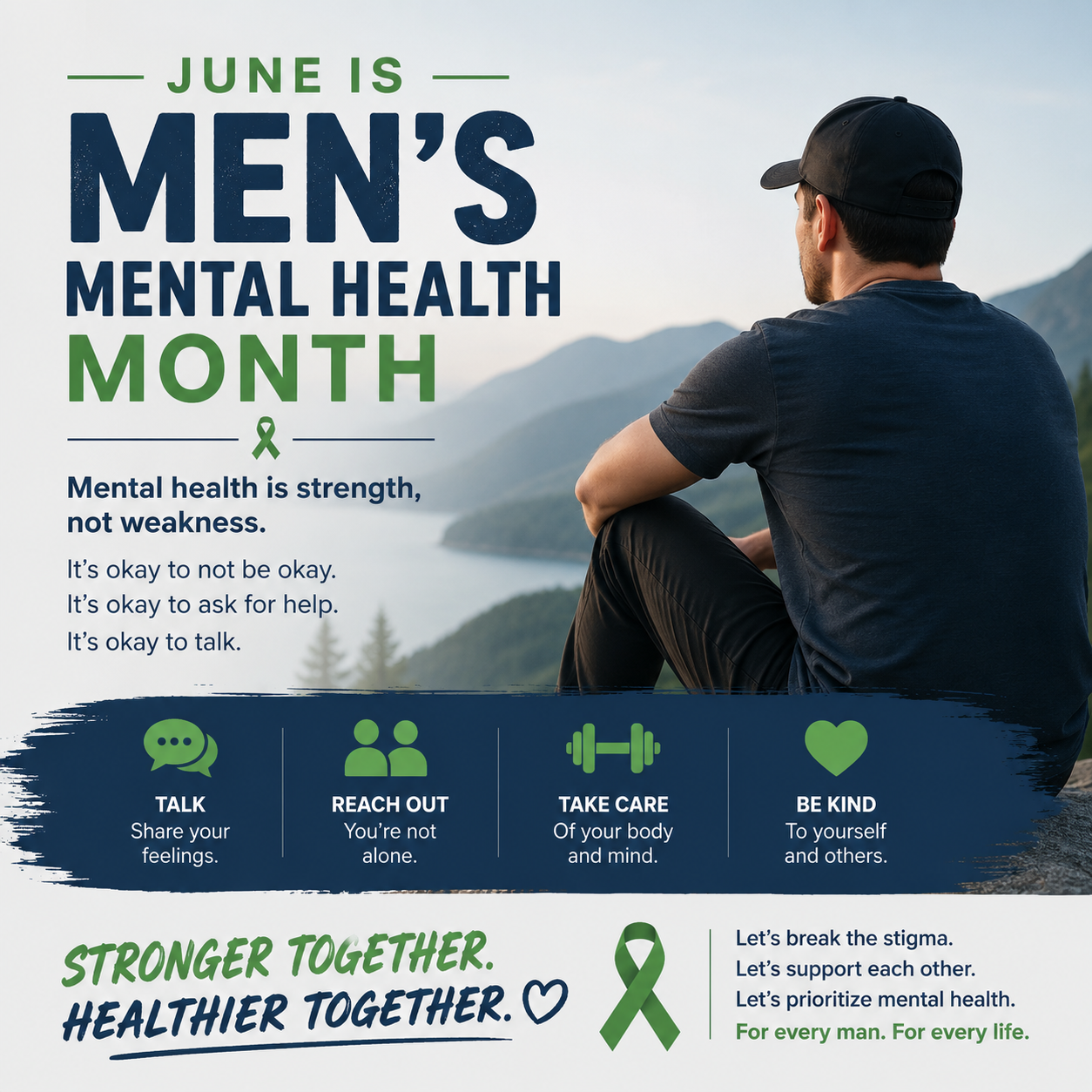
Every June, a quiet but urgent conversation resurfaces across workplaces, health systems, and living rooms: men’s mental health. It doesn’t get the cultural spotlight that other awareness months command, and that’s precisely the problem. Men’s Mental Health Month exists because, for decades, men’s emotional struggles have been minimized, misread, or missed entirely — right up until they show up as a crisis.
This isn’t a niche issue. It’s a public health emergency hiding in plain sight, dressed up as stoicism, “toughness,” or simply being “fine.” This article breaks down what Men’s Mental Health Month is, why it started, what the numbers actually say, why so many men stay silent, and — most importantly — what genuinely helps.
What Is Men’s Mental Health Month?
Men’s Mental Health Month is observed each June in the United States, running alongside the broader Men’s Health Month. It’s worth clearing up a common point of confusion: many people associate men’s mental health awareness with November, thanks to the widely known Movember campaign, which primarily raises money and awareness for prostate cancer, testicular cancer, and men’s mental health through mustache-growing challenges. But June is the officially recognized month dedicated specifically to men’s health and mental wellbeing in the U.S., and it typically includes Men’s Health Week, observed the week leading up to Father’s Day.
The observance traces back to 1994, when the U.S. Congress established National Men’s Health Week, which later expanded into a full month and gained international recognition. The goal from the outset was to spotlight health issues that disproportionately affect men and boys — shorter life expectancy, higher rates of substance use disorders, and significantly elevated suicide rates — issues that had long been under-discussed compared to their scale.
Men’s Health Month 2026 carries the theme “Partners in Care: Advancing Men’s Health Through Connection, Education, and Advocacy,” with an emphasis on empathy and connection — a fitting frame, since connection (or the lack of it) sits at the center of most conversations about male mental health.
The Numbers: A Sobering Picture
Statistics can feel abstract until you sit with what they actually represent — a father, a coworker, a neighbor, a friend. Here’s what the current data shows:
- Men account for roughly 80% of all suicide deaths in the United States, despite making up roughly half the population.
- Men die by suicide at a rate nearly four times higher than women — a gap that has remained stubbornly consistent for years.
- Suicide deaths among men rose more than 59% between 2001 and 2022.
- Around 1 in 5 adult men in the U.S. experiences a mental health condition in any given year. Among young men aged 18–25, that figure climbs sharply, with some research placing it closer to 1 in 3.
- An estimated 6 million American men experience depression annually.
- Roughly 10% of all men experience depression or anxiety, yet fewer than half of that group receive any treatment.
- Suicide is a leading cause of death among men aged 15–34, while the highest suicide rates overall occur among men aged 75 and older — a detail that complicates the assumption that this is purely a “young men’s issue.”
- An estimated 40% of men say they have never spoken to anyone — not a therapist, not a friend, not a partner — about their mental health.
Perhaps the most unsettling statistic isn’t about silence at all. Research has found that a majority of men who died by suicide had actually accessed some form of mental health service in the year before their death — but many described feeling misunderstood, dismissed, or as though their symptoms weren’t taken seriously. That single finding reframes the entire conversation: this isn’t only a story about men refusing to ask for help. It’s also a story about a system that doesn’t always know what to do with them when they do.
Why Men Struggle to Seek Help
It’s tempting to reduce this entire issue to a single word: stigma. And stigma is real — messages like “man up,” “boys don’t cry,” and “handle it yourself” get absorbed early, often before a boy has the vocabulary to describe what he’s feeling in the first place. Many boys grow up with little to no education about emotional wellbeing, even as they’re taught plenty about physical fitness and nutrition.
But stigma alone doesn’t fully explain the treatment gap. A few other forces are just as important:
- Depression doesn’t always look like depression: The clinical picture most people carry in their heads — sadness, tearfulness, withdrawal — is only part of the story for many men. In practice, male depression often shows up as irritability, anger, restlessness, fatigue, trouble concentrating, or a noticeable uptick in alcohol or substance use.
- The language of mental health support often misses the mark: Much of therapy marketing leans soft, emotionally expressive, and vulnerability-forward — valuable qualities, but ones that can feel foreign or even alienating to men who’ve spent a lifetime being told to suppress exactly that kind of expression. The message isn’t wrong, but the packaging sometimes fails to land.
- Self-medication fills the gap: When men don’t feel equipped to name what they’re going through, they often manage it in other ways — overworking, drinking, doom-scrolling, or channeling everything into physical intensity. These behaviors can look like coping on the surface. Underneath, they tend to compound the original problem rather than resolve it.
It’s Not Just a “Young Men’s” Issue
One of the more overlooked data points in men’s mental health is age distribution. While suicide is indeed a leading cause of death for men in their teens, twenties, and thirties, the highest suicide rates by age group actually occur among men 75 and older. Isolation, the loss of a spouse or close friends, retirement-related identity loss, and untreated chronic health conditions all play a role. Because most public conversations about men’s mental health center on younger demographics — college students, new fathers, young professionals — older men risk being left out of a conversation that affects them profoundly, and often silently.
The Physical-Mental Health Connection
Men’s Health Month deliberately bundles physical and mental health together, and there’s a good reason for that. More than half of American men live with hypertension, and nearly 40% of men over 20 are living with obesity. These aren’t separate issues from mental health — they’re deeply intertwined. Chronic stress affects cardiovascular health. Poor sleep worsens mood regulation. Untreated anxiety can manifest as physical tension, gastrointestinal issues, or elevated blood pressure. And many men who would never voluntarily bring up “feeling depressed” will mention insomnia, fatigue, or stress to a doctor during a routine physical — which makes primary care visits a critical, under-used entry point into mental health support.
Health disparities also aren’t distributed evenly. Data shows that men from some racial and ethnic groups — Black men in particular — experience higher rates of hypertension, diabetes, and heart disease, along with earlier onset and more severe outcomes. Addressing men’s mental health without acknowledging these disparities leaves out some of the men who need support most.
Recognizing the Warning Signs
Because male depression and anxiety often present atypically, it helps to know what to actually watch for — in yourself or someone you care about:
- Increased irritability, anger, or aggression that seems disproportionate or out of character
- Withdrawing from friends, family, or activities that used to bring enjoyment
- A noticeable increase in alcohol or substance use
- Chronic fatigue, trouble sleeping, or changes in appetite
- Difficulty concentrating or a drop in work performance
- Risk-taking behavior or recklessness
- Physical complaints without a clear medical cause — headaches, stomach issues, unexplained pain
- Talking about being a burden to others, or expressing hopelessness, even in an offhand or joking way
None of these signs, on their own, confirms a mental health condition. But a cluster of them, especially a noticeable shift from someone’s baseline, is worth taking seriously — not brushing off as “just stress” or “just having a rough patch.”
What Actually Helps
Awareness campaigns are valuable, but data suggests that awareness alone doesn’t move the needle much on outcomes. What tends to make a measurable difference is more specific:
- Naming the feeling, even imperfectly: You don’t need clinical language to start. “Something feels off” is enough of an opening. The specific words matter far less than the act of saying anything out loud to one other person. That first sentence tends to be the hardest part — and also the most important.
- Treating therapy like a trial, not a lifelong commitment: A common reason men don’t return after a bad first session is that they interpret the mismatch as proof therapy “doesn’t work for them.” In reality, fit matters enormously, and switching providers after a few sessions is a completely normal part of the process, not a failure.
- Reducing reliance on self-medicating habits: If alcohol, overworking, or compulsive scrolling has become the primary way of getting through the day, that’s worth examining honestly — not as a moral failing, but as a signal that the underlying stress hasn’t actually been addressed, just postponed.
- Creating low-stakes spaces for conversation: Not every meaningful conversation about mental health needs to happen in a therapist’s office. Barbershops, gyms, workplaces, places of worship, and long drives with a friend have all proven to be effective, low-pressure settings where men are more likely to open up.
What Communities and Employers Can Do
Individual action matters, but systemic change requires more than personal willpower. Organizations and communities observing Men’s Mental Health Month can take concrete steps:
- Normalize mental health check-ins as part of routine workplace culture, not just a once-a-year HR email
- Ensure health insurance and employee assistance programs make therapy access genuinely simple — few steps, fast scheduling, real provider matching
- Train primary care providers to screen for depression and anxiety using language and framing that resonates with male patients, rather than defaulting to a one-size-fits-all approach
- Share real stories from men who’ve sought help, since specific, relatable accounts tend to reduce stigma more effectively than statistics alone
- Support community spaces — sports leagues, faith communities, veteran networks, fatherhood groups — that create informal opportunities for men to connect
Myths vs. Facts About Men’s Mental Health
A lot of well-meaning advice about men’s mental health is built on assumptions that don’t hold up. Separating the myths from the facts matters, because the wrong assumption can quietly discourage someone from reaching out.
- Myth: Men just don’t experience mental health struggles as intensely as women: Fact: Men experience the same range of conditions as women — anxiety disorders, depression, PTSD, bipolar disorder, and eating disorders — often at similar underlying rates. What differs is diagnosis and treatment rates, not the presence of the struggle itself. Because men are diagnosed and treated less often, the visible numbers can create the illusion that the underlying condition is rarer, when in reality it’s simply going undetected.
- Myth: If a man really needed help, he’d ask for it: Fact: This assumes help-seeking is purely a matter of willpower, ignoring everything discussed above — the friction of finding a provider, the mismatch in therapeutic language, and the very real possibility that a first attempt at getting help went poorly and was never tried again. Access and fit are structural issues, not just personal ones.
- Myth: Talking about feelings is the only valid form of processing mental health struggles: Fact: While verbal processing is valuable, it’s not the only path. Physical activity, structured routines, creative outlets, and even working with your hands have all been shown to help regulate mood and reduce anxiety. The goal isn’t to force every man into the same mold of emotional expression — it’s to expand the number of legitimate entry points into care.
How the Conversation Differs Across Cultures
Men’s mental health isn’t a uniquely American concern, though the specific observance in June is a U.S.-centric one. Around the world, the shape of the stigma shifts depending on cultural norms around masculinity, family structure, and access to healthcare infrastructure.
In many cultures, the expectation that men serve as the primary financial provider adds a specific layer of pressure: struggling mentally can feel synonymous with failing to provide, which makes disclosure feel riskier than it might elsewhere. In collectivist cultures, where family reputation is closely tied to individual behavior, seeking mental health treatment can carry a stigma that extends beyond the individual to the household.
This global context matters because it’s a reminder that “man up” isn’t a uniquely American phrase — it has cultural cousins everywhere, even if the exact wording changes. Campaigns like Movember have tried to build an international, cross-cultural bridge specifically because the underlying problem — men underreporting distress and underusing care — shows up in strikingly similar patterns across very different societies.
Common Questions About Men’s Mental Health Month
Is Men’s Mental Health Month the same as Movember?
No. Movember is an international charity campaign held in November focused on prostate cancer, testicular cancer, and men’s mental health and suicide prevention, primarily through fundraising via mustache-growing.
Why is suicide risk highest among older men if younger men are talked about more often?
Public conversations tend to center on younger men — college students, new fathers, early-career professionals — partly because they’re a more visible, more online, and more frequently surveyed demographic. But older men, particularly those over 75, face compounding risk factors: the loss of a spouse, shrinking social circles after retirement, declining physical health, and a lifetime of the same stigma that discouraged help-seeking in earlier decades. Their struggles are just as real, even though they generate far less public attention.
Does therapy actually work for men, given how differently depression can present?
Yes — but fit matters more than it’s often given credit for. Approaches that focus heavily on identifying and verbalizing emotions may not resonate with every man immediately, particularly early on. Some men respond better to more structured, solution-focused therapy styles, or to providers who explicitly acknowledge that emotional expression can look different across individuals. The evidence doesn’t suggest therapy is less effective for men — it suggests that mismatched delivery is a bigger barrier than the treatment itself.
What’s one small step someone can take today?
Pick one person and send one honest sentence. It doesn’t need to be dramatic or fully formed. “Work’s been a lot and I haven’t been sleeping” is enough to open a door that’s often been closed for years. The specific first step matters less than simply taking one.
A Month, Not a Finish Line
Here’s the uncomfortable truth: no single month fixes a public health gap that’s taken decades to form. Men’s Mental Health Month isn’t a solution in itself — it’s a prompt. A reminder to make the appointment that’s been sitting untouched on a calendar. A nudge to ask a friend a slightly more specific question than usual. A reason for a workplace to actually look at whether its mental health benefits are being used, and if not, why.
The data is clear that the barriers aren’t primarily about awareness anymore — most people know, in the abstract, that men’s mental health is a real issue. The barriers are about access, about a system that doesn’t always speak the language men are comfortable with, and about the residue of decades of messaging that equated silence with strength.
If June is the month this conversation gets louder, the goal should be making sure it doesn’t go quiet again come July. That means workplaces keeping mental health resources visible and used year-round. It means friends checking in without waiting for an occasion. And for any man reading this who recognizes even a piece of himself in these numbers, it means treating “I’m fine” as a starting point for a harder, more honest sentence — not the end of the conversation.
If You or Someone You Know Is Struggling
If you’re having thoughts of suicide or are in crisis, you can call or text 988 to reach the Suicide and Crisis Lifeline in the United States, available 24/7. You’re outside the U.S., search for your country’s local crisis line, as availability and numbers vary by region. You don’t have to be in an active crisis to reach out — these lines are also there for people who just need to talk something through.