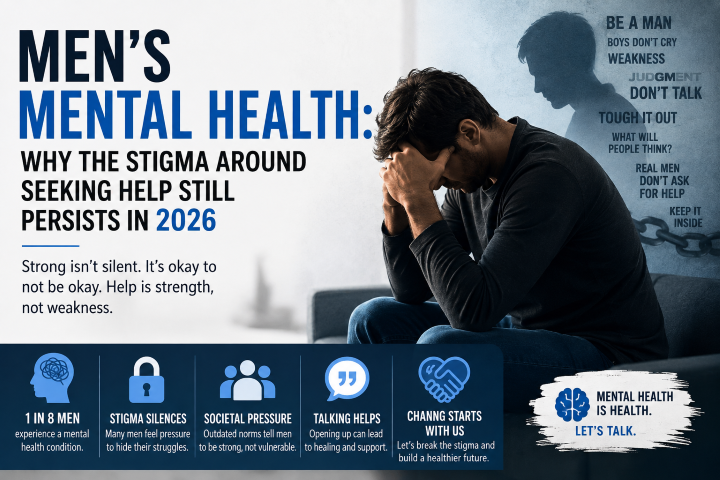
Ask a man how he’s really doing, and the odds are good you’ll hear “I’m fine” — even when he isn’t. That reflex runs deep, and in 2026, despite years of awareness campaigns, celebrity openness, and a genuinely growing conversation around men’s mental health, the numbers show that reflex hasn’t gone away. Men’s mental health stigma remains one of the most persistent public health issues today — it’s just being challenged more than it used to be.
This article looks honestly at where things actually stand: how big the treatment gap still is, why stigma persists even as attitudes shift, and what’s genuinely working for the men who are starting to close that gap.
The Numbers Nobody Should Look Away From
Let’s start with what’s actually happening, because the scale of this issue is easy to underestimate.
Men and women experience anxiety and depression at nearly identical rates. But the path each group takes once symptoms show up looks very different. Only about 40% of men with a reported mental illness received mental health care in the past year, compared with 52% of women. And when men do delay seeking help, they don’t delay by a little — men often wait an average of 11 years after symptoms first appear before seeking treatment, a delay that can allow a manageable problem to become a much more severe one.
The consequences of that delay are stark. Men die by suicide at nearly four times the rate of women, and suicide remains the leading cause of death for men under 35. More than 6 million men experience depression each year, and the majority never seek help for it. Perhaps most telling of all: more than 60% of men who died by suicide had actually accessed mental health care services within the previous year — meaning the issue often isn’t just “getting men in the door,” but making sure the care they receive once there genuinely reaches them.
What’s Actually Driving the Silence
Stigma isn’t one single thing — it’s a combination of internal beliefs, social pressure, and structural gaps that reinforce each other.
The “tough guy” conditioning starts early: From childhood, many men absorb a consistent message: emotions are weakness. Phrases like “toughen up,” “don’t cry,” and “be the man of the house” build an internal belief system long before adulthood, and that belief system doesn’t just disappear when a man starts struggling — it often becomes the very thing stopping him from asking for help.
Embarrassment and stigma remain common, named reasons for staying silent: About 29% of men say they’re too embarrassed to talk about their mental health, and 20% specifically cite stigma as their reason for staying quiet. When men do open up, 66% say they’d share their feelings with a partner rather than with anyone else.
For some men, it takes a crisis point to act: About 40% of men say it would take thoughts of suicide or self-harm to actually push them toward seeking professional help — a genuinely sobering statistic that highlights just how high the bar has been set for “acceptable” reasons to reach out.
Work and money are the biggest named stressors: The leading contributors to men’s mental health struggles are work (32%), finances (31%), and physical health (23%), with roughly 191,000 men each year reporting stress, depression, or anxiety caused or worsened specifically by their jobs.
Access isn’t equal across all men: Disparities based on race, ethnicity, and geography are significant — non-Hispanic Black and Hispanic men are considerably less likely to receive mental health treatment than their non-Hispanic White counterparts, pointing to systemic barriers and cultural factors that compound stigma rather than existing separately from it.
The Part of the Story That’s Actually Changing
Here’s what’s genuinely different in 2026, and it’s worth taking seriously: the progress, while incomplete, is real.
Recent estimates suggest around 4 in 10 men now receive care when needed — a meaningful shift from where things stood just a few years earlier. Telehealth in particular has become a significant driver of this change. Some clinics report roughly a 30% increase in male patients opting for online counseling specifically, and it’s not hard to understand why: virtual sessions let men seek help more discreetly, without the added friction of walking into a physical office where someone might see them.
Group and peer-based models are proving especially effective at breaking through isolation. Hearing other men speak openly about their own experiences does something that a solo therapy referral often can’t — it interrupts the belief that struggling alone is normal or expected. As one clinician put it, stigma doesn’t function as a fixed personality trait; it operates as a learned behavior reinforced by social environment, which means that when the environment genuinely changes, the behavior can change with it too.
Framing matters as well. Integrating physical health into treatment — sleep quality, exercise, nutrition — has had a notable effect, since it lets mental health be discussed through a lens many men already use to think about performance and overall wellbeing, without minimizing the psychological depth of the work itself. This is also exactly why sleep, one of the most overlooked pillars of men’s health, deserves real attention on its own — we go deeper into that connection in our guide on how much sleep men really need.
What Actually Helps: Practical Starting Points
If you’re a man who recognizes some of this in yourself, or you’re supporting one who does, here’s what the current evidence points toward:
Start with a low-friction entry point: Telehealth and app-based counseling remove much of the logistical and social friction that keeps men from making that first appointment. If walking into a therapist’s office feels like too big a first step, a virtual session from home is a legitimate, evidence-backed alternative — not a lesser one.
Consider peer or group settings, not just one-on-one therapy: If isolation is part of what’s keeping you stuck, hearing other men discuss similar struggles can do something individual therapy alone sometimes can’t — it normalizes the experience in real time.
Watch for symptoms that don’t look like “textbook” depression: Men’s mental health struggles often show up as anger, irritability, physical complaints, or a subtle pulling away from relationships and hobbies, rather than the more commonly recognized signs of sadness or hopelessness. It’s also worth ruling out physical contributors: hormonal issues like low testosterone can produce symptoms that closely mimic depression, including low mood, fatigue, and irritability, which is why it’s worth reading our guide on signs of low testosterone in men if these symptoms sound familiar.
Talk to your primary care provider if therapy feels like too big a first step: A regular doctor can be a lower-stigma entry point into the conversation, helping connect physical symptoms to underlying mental health factors and providing a referral when you’re ready for more specialized support. If cost or hospital access is part of what’s holding you back from seeking any kind of medical care. It’s worth understanding your options — our guide on how cashless hospitalization works in India breaks down how to avoid a major financial barrier getting in the way of care.
If You’re Supporting a Man Who’s Struggling
If someone in your life fits this pattern, a few things genuinely help: ask directly rather than accepting “I’m fine” at face value, don’t treat vulnerability as something to fix immediately, and be patient with a slower path toward professional help rather than pushing for an instant solution. Given that a large share of men say they’d open up to a partner before anyone else, that role — as a first point of contact rather than a substitute for professional care — genuinely matters, even if it’s also worth encouraging a broader support system beyond just one person.
Final Thoughts
The stigma around men’s mental health hasn’t disappeared in 2026 — the treatment gap remains wide, and the consequences of that gap are still measured in real, preventable loss. But something is genuinely shifting underneath the surface: more men are reaching out, telehealth is lowering the barrier to that first step, and peer-based support is proving that isolation, not the underlying struggle itself, is often the bigger obstacle.
The men showing up for care in 2026 aren’t doing it because stigma has vanished. They’re doing it because something inside them shifted first — and that shift is worth protecting, supporting, and making easier for the men who haven’t gotten there yet.
Frequently Asked Questions
Why do men wait so long to seek mental health treatment?
Men often delay seeking treatment for an average of 11 years after symptoms first appear, driven by a combination of internalized “tough guy” conditioning, workplace stigma, embarrassment, and a lack of low-friction entry points into care. This delay frequently allows manageable symptoms to become significantly more severe.
What percentage of men actually get mental health treatment?
Only about 40% of men with a reported mental illness received mental health care in the past year, compared with 52% of women, though recent estimates suggest around 4 in 10 men now receive care when needed — a meaningful improvement from previous years.
What are less obvious signs of depression in men?
Depression in men often shows up as anger, irritability, physical complaints like chronic pain or insomnia, or withdrawal from relationships and hobbies, rather than the more commonly recognized signs of sadness or hopelessness. These less obvious patterns are frequently missed or misread as simple mood or personality changes.
Does online therapy actually work as well as in-person therapy for men?
Outcome data suggests it can be genuinely effective — in one recent survey of an online therapy platform, 72% of users saw a reduction in symptoms and 62% reached remission. Telehealth also removes much of the social and logistical friction that specifically keeps men from seeking care in the first place.
What should I do if I’m worried about a man in my life?
Ask directly how he’s really doing rather than accepting a quick “I’m fine,” avoid immediately trying to fix or minimize what he shares, and gently point toward low-friction options like telehealth or a conversation with a primary care provider if formal therapy feels like too big a first step.
Disclaimer: This article is for general informational purposes and is not a substitute for professional medical or mental health advice. If you or someone you know is struggling with thoughts of suicide or self-harm, please reach out to a mental health professional or a crisis line in your country immediately — you don’t have to wait for a crisis point to ask for help, and support is available now.
Related reads: