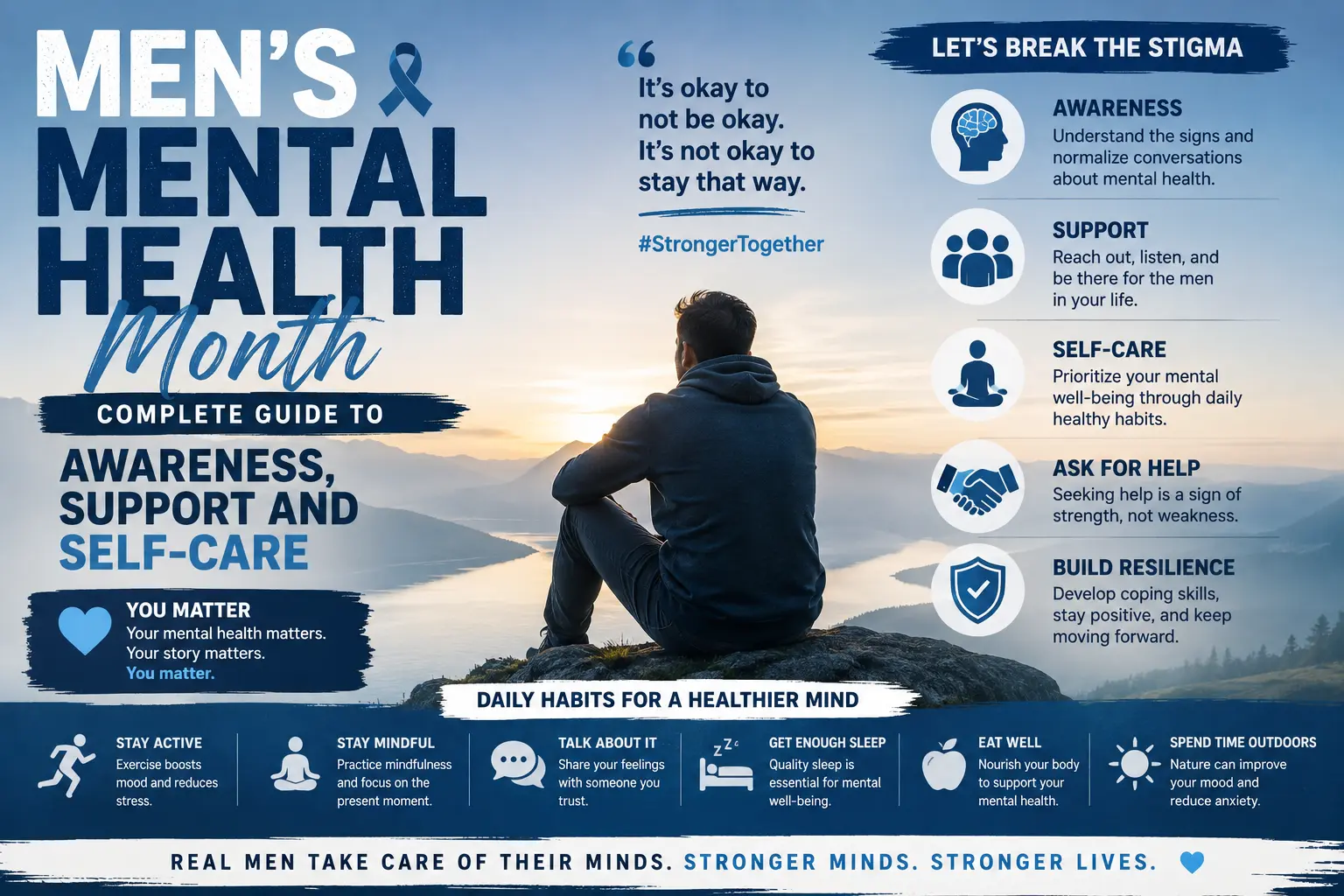
Every June, communities, healthcare organizations, and advocacy groups across the country come together to observe Men’s Mental Health Month. It’s a dedicated period meant to shine a light on a public health issue that too often goes unspoken: the emotional and psychological wellbeing of men and boys. While mental health conversations have opened up significantly over the past decade, men continue to face unique barriers that keep them from acknowledging struggles, seeking treatment, and building sustainable habits of self-care.
This guide takes a deep, practical look at Men’s Mental Health Month — why it exists, the statistics that make it urgent, the signs of struggle that are often missed, and the concrete steps men, families, and communities can take to build lasting support systems. Whether you’re observing this month for yourself, a partner, a father, a brother, or a friend, this guide is designed to give you real, usable information.
What Is Men’s Mental Health Month?
Men’s Mental Health Month is observed every June in the United States, running alongside the broader Men’s Health Month and Men’s Health Week, which typically falls the week leading up to Father’s Day. The observance began as an extension of National Men’s Health Week, which the U.S. Congress first recognized in 1994, and has since grown into a month-long, internationally recognized campaign focused on both physical and emotional wellbeing.
It’s worth noting that some countries — including the United Kingdom and Australia — place a stronger emphasis on men’s mental health in November, tying it to International Men’s Day (November 19) and the well-known “Movember” movement, which began as a prostate cancer awareness campaign and has since expanded to include mental health advocacy. In the U.S., however, June remains the primary month dedicated specifically to men’s mental health awareness.
The purpose of Men’s Mental Health Month is straightforward but critical: to challenge the stigma that keeps men silent, to educate the public on how mental health struggles show up differently in men, and to connect men with resources, treatment, and community support before a crisis point is reached.
A Brief History of Men’s Mental Health Month
To understand why this observance carries the weight it does today, it helps to look at how it developed. National Men’s Health Week was formally established by Congress in 1994, timed deliberately to fall right before Father’s Day so that families would be thinking about the health of the men in their lives at a moment already centered on fatherhood and connection. Over time, that single week expanded into a full month of programming, and the scope broadened well beyond physical checkups and screenings.
For much of its early history, men’s health campaigns concentrated almost entirely on physical concerns — cardiovascular disease, prostate cancer, and general preventive care. Mental health was rarely part of the conversation. That began to shift as rising suicide rates, growing rates of diagnosed depression, and increasing public awareness of burnout and substance misuse among men made it impossible to separate emotional wellbeing from physical health. Advocacy groups, healthcare systems, and nonprofit organizations began building mental health programming directly into June’s existing framework, and by the 2010s, Men’s Mental Health Month had become a recognized companion observance to Men’s Health Month.
Why Men’s Mental Health Month Matters
It’s easy to view awareness months as symbolic gestures, but the numbers behind men’s mental health tell a much more urgent story.
- Roughly one in five men experiences a diagnosable mental health condition in any given year, according to the National Institute of Mental Health.
- Among younger men, particularly those between 18 and 25, that number climbs even higher, with more than a third reporting a mental health condition.
- Men are significantly less likely than women to seek professional mental health treatment, even when they are experiencing clear symptoms of depression, anxiety, trauma, or substance use disorders.
- Men die by suicide at a rate nearly four times higher than women, and men account for a large majority of all suicide deaths in the U.S.
- Millions of American men experience depression each year, yet a large share never receive a formal diagnosis or treatment.
These figures aren’t just statistics — they represent fathers, sons, coworkers, and friends who are quietly carrying more than they let on. The gap between how often men experience mental health struggles and how rarely they seek help is the central problem that Men’s Mental Health Month exists to address.
Why Men Struggle to Seek Help
Understanding the “why” behind these numbers is essential to changing them. Several overlapping factors keep men from reaching out:
1. Cultural Messaging About Masculinity
Many men are raised with the idea that vulnerability equals weakness. Phrases like “man up,” “shake it off,” or “boys don’t cry” are absorbed early and shape how men process — or suppress — their emotions well into adulthood. This conditioning teaches men to value stoicism and self-reliance over emotional openness, which can make asking for help feel like a personal failure rather than a healthy step.
2. Fear of Judgment
Even in workplaces and friend groups that claim to be supportive, many men fear that admitting to anxiety, depression, or burnout will change how others see them — professionally, socially, or romantically. This fear often keeps struggles hidden until they become unmanageable.
3. Lack of Awareness of Symptoms
Depression and anxiety don’t always look the way pop culture portrays them. Because male-pattern symptoms can differ from the classic presentation of sadness or tearfulness, many men (and the people around them) simply don’t recognize what they’re seeing as a mental health issue.
4. Limited Access or Uncomfortable Systems
Even when men decide to seek help, they may encounter long waitlists, high costs, or a therapy model that doesn’t feel like a natural fit. Traditional talk therapy, which emphasizes verbal emotional processing, can feel unfamiliar or uncomfortable for men who haven’t had much practice articulating feelings.
5. Underdiagnosis by Providers
Healthcare providers themselves may miss the signs. Because men often present with irritability, physical complaints, or risk-taking behavior rather than overt sadness, clinicians can sometimes overlook depression or anxiety during routine visits.
What Depression and Anxiety Actually Look Like in Men
One of the most valuable things Men’s Mental Health Month can do is correct the public’s mental image of what a struggling man looks like. Depression in men frequently hides behind behaviors that don’t get labeled as “mental health issues” at all. Common signs include:
Behavioral changes
- Increased irritability, anger, or aggression
- Risky behavior, including reckless driving, excessive gambling, or infidelity
- Increased or new substance use (alcohol, drugs, or misuse of prescription medication)
- Withdrawing from friends, family, or social activities
- Overworking or using work as an escape from emotional discomfort
Physical symptoms
- Persistent fatigue or low energy that doesn’t improve with rest
- Unexplained aches, headaches, or digestive issues
- Significant changes in appetite or weight
- Disrupted sleep — either insomnia or sleeping far more than usual
Emotional concealment
- Difficulty naming or describing feelings
- Appearing numb, flat, or emotionally distant
- Avoiding conversations that touch on personal struggles
- Deflecting concern with humor or minimization (“I’m fine, just tired”)
Functional decline
- Trouble concentrating or making decisions
- Losing interest in hobbies, sports, or activities once enjoyed
- Neglecting responsibilities at work or home
- A general sense of being “checked out” of daily life
If you notice several of these signs — in yourself or someone you care about — persisting for more than two weeks, it’s worth taking seriously, even if nothing resembles textbook sadness.
Recognizing a Crisis
Some situations require immediate action rather than a wait-and-see approach. Warning signs that suggest a mental health crisis include:
- Talking about wanting to die, disappear, or “not be a burden”
- Giving away possessions or making end-of-life arrangements
- A sudden sense of calm after a period of visible distress
- Increased substance use paired with hopelessness
- Direct or indirect statements about self-harm
If you or someone you know is showing these signs, treat it as urgent. In the United States, you can call or text 988 to reach the Suicide & Crisis Lifeline, available 24/7 and free of charge. If there is immediate danger, call 911 or go to the nearest emergency room.
How to Support the Men in Your Life
Supporting a man who is struggling requires a slightly different approach than the conversations we’re often taught to have. Because many men are uncomfortable initiating emotional conversations directly, the way you open the door matters.
Lead With Observation, Not Diagnosis
Instead of asking “Are you depressed?” — which can feel clinical or confrontational — try something rooted in what you’ve actually noticed: “You’ve seemed pretty wiped out lately, and I wanted to check in.” This approach feels less like an accusation and more like genuine concern.
Create Low-Pressure Opportunities to Talk
Many men open up more easily during shared activities — driving, working on a project, fishing, exercising — than in face-to-face sit-down conversations. The lack of direct eye contact and the presence of a shared task can lower the emotional stakes of talking.
Normalize Professional Help
Frame therapy or counseling as a performance tool rather than a last resort. Athletes have coaches. Executives have advisors. Mental health support functions the same way — it’s a resource for people who want to function at their best, not just those in crisis.
Be Patient With the Pace
Men who aren’t used to discussing emotions may need more time, more repetition, and multiple conversations before they open up. A single check-in that gets deflected doesn’t mean the door is closed — it may just mean more trust needs to be built first.
Follow Up Consistently
A single “How are you?” is easy to brush off. Consistent, low-key check-ins over weeks and months communicate that your concern isn’t a one-time formality — it’s ongoing and genuine.
Self-Care Strategies for Men
Self-care is often marketed in ways that don’t resonate with men, framed around spa days or journaling prompts that can feel disconnected from how many men actually process stress. Effective self-care for men doesn’t need to look a particular way — it needs to be sustainable and honest. Here are practical, evidence-informed strategies:
1. Build Movement Into Your Routine
Physical activity remains one of the most consistently effective tools for improving mood and reducing anxiety. This doesn’t have to mean structured workouts — walking, sports leagues, lifting, or cycling all count. The goal is regular movement, not perfection.
2. Protect Your Sleep
Sleep deprivation and mental health struggles feed each other in a cycle. Prioritizing a consistent sleep schedule, limiting screens before bed, and treating rest as a non-negotiable part of health — not a luxury — can meaningfully improve emotional regulation.
3. Reduce Isolation on Purpose
Many men’s social circles shrink significantly after their twenties, especially once friendships built around school or single life fade. Rebuilding a support network takes intentional effort: joining a recreational league, reconnecting with old friends, or finding a men’s group centered on a shared interest.
4. Limit Numbing Behaviors
Alcohol, excessive scrolling, and overworking are common ways men numb discomfort rather than process it. None of these are inherently “bad” in moderation, but it’s worth honestly evaluating whether they’re being used to avoid dealing with something underneath.
5. Find a Language for Feelings
If naming emotions feels unnatural, start small. Instead of trying to identify complex feelings right away, begin with basic categories: stressed, tired, frustrated, low, on edge. Building this vocabulary over time makes it easier to communicate what’s actually going on, both to yourself and to others.
6. Consider Therapy Formats That Fit You
Traditional talk therapy isn’t the only option. Some men respond well to structured, goal-oriented approaches like cognitive behavioral therapy (CBT), which focuses on concrete skills rather than open-ended emotional exploration. Others prefer group therapy, where shared experience reduces the pressure of individual vulnerability. It’s worth trying different formats rather than assuming therapy “isn’t for you” after one uncomfortable session.
7. Set Boundaries Around Work
Many men tie their sense of identity closely to their careers or providing for their families, which can make burnout especially hard to recognize. Building in deliberate boundaries — set work hours, actual vacation time, hobbies unrelated to productivity — helps protect against the slow erosion of mental health that chronic overwork can cause.
Building a Culture of Support Beyond June
While Men’s Mental Health Month provides a valuable spotlight, the real impact comes from what continues after the month ends. Meaningful, lasting change requires:
- In workplaces: Employers can offer mental health days, promote Employee Assistance Programs (EAPs) without stigma, and train managers to recognize signs of struggle among their teams.
- In schools and youth programs: Teaching boys emotional vocabulary early, rather than waiting until adulthood, helps prevent the suppression patterns that make help-seeking so difficult later in life.
- In healthcare systems: Providers can be trained to screen for male-pattern depression symptoms — irritability, anger, and physical complaints — rather than relying solely on traditional depression checklists.
- In families: Modeling openness at home, especially from fathers to sons, helps break generational patterns of silence around emotional struggles.
- In friendships: Regular, genuine check-ins — not just during a crisis — build the kind of trust that makes it easier for men to reach out when they actually need to.
Common Myths About Men’s Mental Health — And the Facts
Misconceptions about men’s mental health don’t just misinform the public — they actively discourage men from seeking help. Addressing them directly is a core part of what Men’s Mental Health Month aims to accomplish.
- Myth: Men don’t experience depression as often as women: Fact: Diagnosed rates of depression are lower in men, but this largely reflects underdiagnosis and underreporting rather than a lower actual prevalence. Because male-pattern symptoms differ from the traditional presentation, many cases go unrecorded in official statistics.
- Myth: Talking about mental health struggles makes a man weak: Fact: Recognizing a problem and taking active steps to address it — rather than ignoring it until it becomes unmanageable — requires more strength and self-awareness than pretending everything is fine.
- Myth: Therapy is only for severe mental illness: Fact: Therapy is used just as often for stress management, relationship issues, career transitions, and general emotional maintenance as it is for diagnosable conditions. Waiting for a crisis before seeking support means missing years of preventive benefit.
- Myth: Men who seem “fine” on the outside are actually fine: Fact: High-functioning depression and anxiety are common. Many men continue to perform well at work, maintain relationships, and meet obligations while privately struggling, which is precisely why loved ones often miss the signs until things become severe.
- Myth: Medication or therapy will change who a man fundamentally is: Fact: Effective treatment is aimed at restoring a person’s baseline functioning and quality of life — not altering personality. Most men who pursue treatment report feeling more like themselves, not less.
Men’s Mental Health Across Different Life Stages
Mental health challenges don’t look identical across a man’s lifespan. Understanding how risk factors shift with age can help identify problems earlier.
Young Men (Ages 18–25)
This age group reports the highest rates of diagnosable mental health conditions among men, often tied to major life transitions — leaving home, starting college or a career, financial pressure, and the loss of built-in social structures like school sports teams or dorm communities. Isolation is a particularly significant risk factor at this stage, as young men frequently lose the social scaffolding that previously connected them to peers.
Midlife Men (Ages 30–50)
Career pressure, financial responsibility, and caregiving demands — for children, aging parents, or both — tend to dominate this stage. Many men in this age range report feeling like they have no space to acknowledge struggle because they’re expected to be the stable figure for everyone else. Divorce, job loss, and health scares are common triggers for depression and anxiety during this period, often compounded by a reluctance to disrupt the image of reliability others depend on.
Older Men (Ages 60+)
Retirement, loss of professional identity, declining physical health, and the death of a spouse or close friends can trigger significant depression in older men — a group that also carries one of the highest suicide risk rates of any demographic. Social isolation becomes a particularly serious risk factor here, especially for men who built much of their identity and social connection around their careers.
Recognizing which pressures dominate at each stage makes it easier to tailor support — a young man struggling with isolation needs a different kind of outreach than a retiree grieving the loss of a lifelong routine.
The Role of Workplaces During Men’s Mental Health Month
Because so much of adult male identity is tied to career and providing for others, workplaces play an outsized role in either reinforcing stigma or helping dismantle it. Organizations that want to meaningfully participate in Men’s Mental Health Month — beyond a single email or poster — can take several concrete steps:
- Audit existing benefits. Many companies already offer Employee Assistance Programs that go unused simply because employees don’t know they exist or fear that using them isn’t confidential.
- Train managers to recognize warning signs. Frontline managers are often the first to notice changes in performance, mood, or reliability, but many aren’t equipped to know how to respond appropriately.
- Normalize taking mental health days explicitly. When leadership visibly uses and talks about mental health time off, it signals that doing so isn’t a career risk.
- Reconsider always-on culture. Chronic availability expectations — after-hours emails, weekend messages — erode the boundaries men need to recover from stress, particularly for those already reluctant to advocate for themselves.
Frequently Asked Questions
When is Men’s Mental Health Month?
Men’s Mental Health Month is observed every June in the United States, running alongside Men’s Health Month and Men’s Health Week, which falls the week before Father’s Day.
Is Men’s Mental Health Month the same as Movember?
No. Movember is an international campaign held in November, originally focused on prostate and testicular cancer awareness, which has since expanded to include mental health. Men’s Mental Health Month, observed in June, is a separate U.S.-based observance with its own history and focus.
What’s the difference between Men’s Health Month and Men’s Mental Health Month?
Men’s Health Month is the broader umbrella observance covering physical health topics like cardiovascular screenings and cancer prevention. Men’s Mental Health Month refers specifically to the emotional and psychological wellbeing component within that broader month.
How can I tell if a man in my life needs professional help rather than just support from friends and family?
If symptoms — withdrawal, irritability, sleep changes, substance use, or loss of interest in usual activities — persist for more than two weeks, or if there is any mention of hopelessness, self-harm, or suicide, it’s time to involve a mental health professional rather than relying solely on informal support.
What should I do if a man refuses to seek help?
Continue to express concern without pressure or ultimatums, share resources without insisting they be used immediately, and take care of your own wellbeing in the process. Respecting autonomy while remaining consistently present often does more than repeated confrontation.
Resources for Men’s Mental Health
If you or someone you know needs support, these resources are a good starting point:
- 988 Suicide & Crisis Lifeline — Call or text 988 for free, confidential support 24/7.
- Crisis Text Line — Text HOME to 741741 to reach a trained crisis counselor.
- SAMHSA National Helpline — 1-800-662-4357, a free, confidential treatment referral service.
- HeadsUpGuys — An online resource specifically designed to support men’s mental health with self-check tools and practical strategies.
- Local therapists specializing in men’s issues — Many directories, including Psychology Today’s therapist finder, allow filtering by specialization in men’s mental health.
Final Thoughts
Men’s Mental Health Month exists because silence has a cost — one measured in strained relationships, untreated illness, and lives lost to suicide. But awareness months work best as a starting point, not an endpoint. Real progress happens in the ordinary moments: a friend who checks in twice instead of once, a father who tells his son it’s okay to say “I’m struggling,” a workplace that treats mental health support as a strength rather than a liability.
If this month prompts even one honest conversation, one overdue appointment, or one moment of a man feeling less alone, it’s doing exactly what it’s meant to do. Mental health isn’t a sign of weakness — it’s a fundamental part of overall health, deserving the same attention, care, and consistency as physical wellbeing.