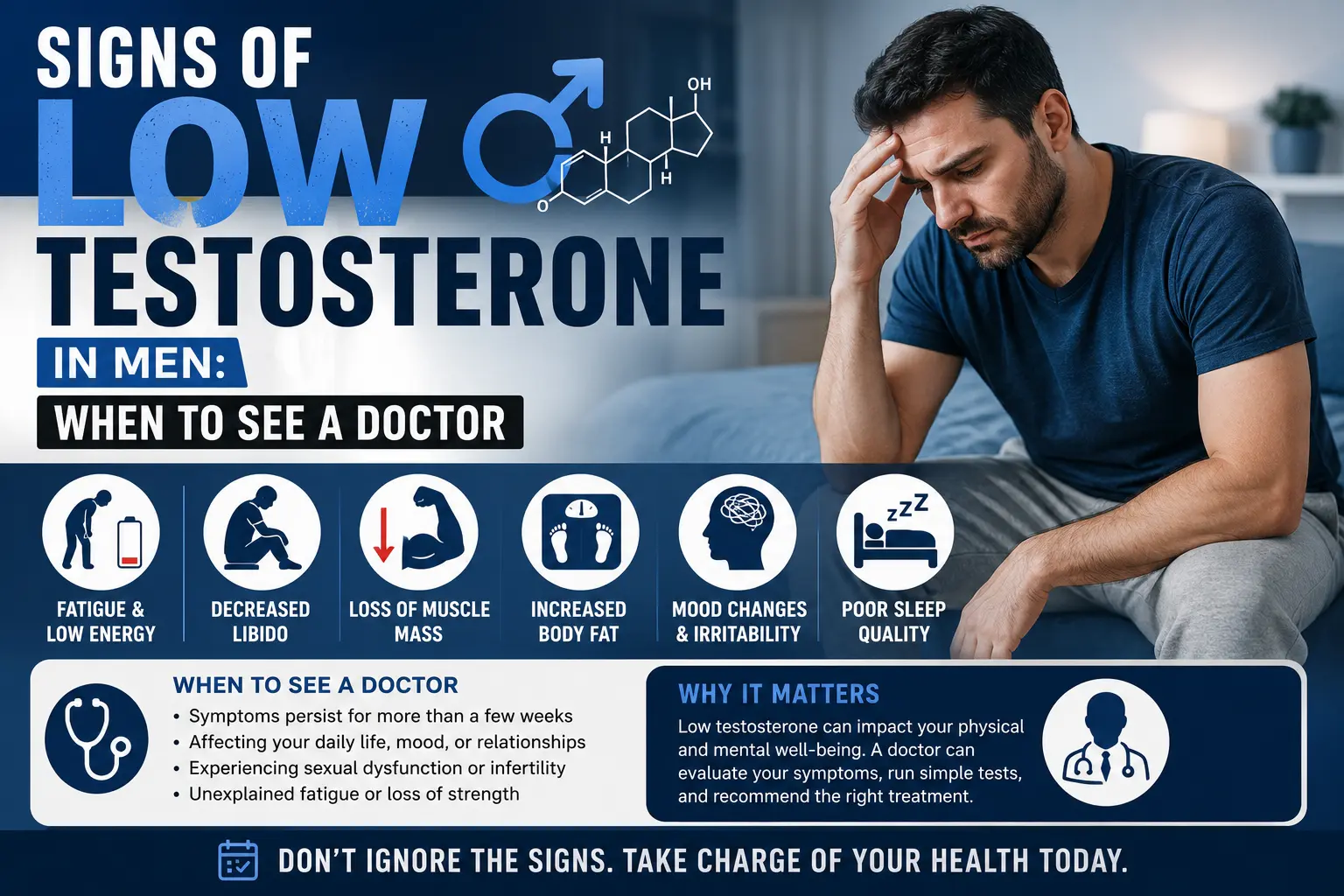
Here’s a statistic worth sitting with: nearly a quarter of men with confirmed testosterone deficiency struggle with symptoms for five years before ever seeing a doctor. Many dismiss it as normal aging, stress, or just “getting older.” Some try to fix it themselves with supplements that research shows rarely work. This guide covers what the actual signs of low testosterone in men are, backed by medical sources, so you know what to watch for and when it’s genuinely time to get checked.
What Is Low Testosterone?
Testosterone is the primary male sex hormone, produced mainly in the testes. It plays a role in muscle mass, bone density, fat distribution, red blood cell production, sex drive, sperm production, mood, motivation, and mental clarity. Levels typically peak in a man’s 20s, then decline gradually by about 1-2% per year starting in his 30s or 40s — this slow decline is a normal part of aging.
Low testosterone (often called “low T”) becomes a medical concern when levels drop enough — generally below 300 ng/dL, though some doctors use a threshold of 250 ng/dL — to cause noticeable symptoms that affect daily life, not just the gradual dip everyone experiences with age.
Physical Signs of Low Testosterone
Persistent fatigue. Feeling exhausted even after a full night’s sleep is one of the most commonly reported symptoms — low energy was reported by roughly 30% of men with confirmed testosterone deficiency in one recent survey.
Reduced muscle mass and strength. Testosterone helps build and maintain muscle. Even with regular exercise, men with low T may struggle to maintain muscle tone, and workouts may start to feel noticeably harder with slower results.
Increased body fat, especially around the abdomen. When testosterone drops, the body tends to hold onto fat more easily, particularly around the midsection, even without major changes in diet.
Hair loss or thinning. Testosterone helps maintain facial and body hair. Sudden thinning or hair loss beyond typical male pattern baldness can be a visible clue.
Bone thinning. Lower testosterone is linked to reduced bone density, which becomes a particular concern for older men and increases fracture risk over time.
Sexual Signs of Low Testosterone
Decreased libido. Everyone’s sex drive naturally fluctuates, but a noticeable and lasting drop — without an obvious explanation like stress or poor sleep — is one of the most common and recognizable signs of low T.
Erectile difficulties. Low Testosterone in Men can affect sexual performance and the ability to achieve or maintain an erection, though this symptom can also stem from unrelated causes like cardiovascular issues, which is part of why proper diagnosis matters.
Mental and Emotional Signs of Low Testosterone
Mood changes, including depression and irritability. These are among the most commonly reported symptoms, alongside fatigue and low libido. Many men don’t connect mood changes to a hormonal cause, which contributes to the years-long delay in seeking help.
Cognitive changes. These tend to be quieter than physical symptoms, but can show up as difficulty concentrating, mental fogginess, or reduced motivation — subtle enough that they’re often dismissed rather than investigated.
Sleep problems. Difficulty falling asleep, trouble staying asleep, or waking up early are recognized symptoms on standardized low-T symptom scales.
An Important Caveat
Several of these symptoms — especially fatigue, low mood, and poor concentration — are what doctors call “non-specific.” They overlap heavily with other conditions, including depression, sleep apnea, thyroid problems, and simple lifestyle factors like chronic stress or poor sleep. Having one or two of these symptoms doesn’t necessarily mean low testosterone is the cause. It’s the combination of several symptoms, especially alongside the more specific ones (reduced libido, erectile changes, muscle loss), that makes a stronger case for getting tested.
Who’s More Likely to Have Low Testosterone?
Certain factors and health conditions raise the likelihood of low T:
- Age — natural decline accelerates gradually after 30-40
- Obesity and metabolic syndrome — linked to increased blood pressure, high blood sugar, excess abdominal fat, and abnormal cholesterol
- Certain medications — including some antidepressants and narcotic pain medications
- Chronic health conditions — including HIV (associated with low T in roughly 30% of cases) and AIDS (around 50% of cases)
- Sleep apnea, diabetes, or untreated depression — often screened for alongside testosterone when symptoms appear
How Doctors Actually Diagnose Low T
A doctor won’t diagnose low testosterone from symptoms alone. Typically, they’ll:
- Take a full health history and physical exam
- Order a blood test measuring total and free testosterone (usually done in the morning, when levels are highest)
- Run additional labs if needed — thyroid function, estradiol, LH/FSH, or cortisol — to rule out other causes
- Review your medications and lifestyle for contributing factors
- Screen for related conditions like sleep apnea, diabetes, or depression
This is exactly why self-diagnosing from an article (including this one) isn’t enough — the symptom overlap with other conditions means testing is the only reliable way to confirm it.
A Word of Caution on Supplements
If you’re tempted to try an over-the-counter “testosterone booster,” it’s worth knowing what the research actually shows: a review of published data on supplements claiming to boost testosterone found that fewer than 25% had any data showing an actual increase, about 10% actually lowered testosterone, and nearly 20% showed no difference at all. Some supplements also contain doses of ingredients like zinc or vitamin B6 far higher than recommended levels. Always talk to a doctor before taking any supplement marketed this way.
When to See a Doctor
Make an appointment if:
- You’re experiencing several of the symptoms above together, particularly low libido, unexplained fatigue, and mood changes
- Symptoms have lasted for weeks or longer without an obvious cause like poor sleep or high stress
- Erectile function has changed noticeably without a clear explanation
- You’re concerned about unexplained muscle loss, weight gain, or hair thinning
Early evaluation matters — not just for symptom relief, but because some underlying causes of low T (like sleep apnea or diabetes) are health conditions worth catching early on their own.
Frequently Asked Questions
Q: What is considered low testosterone?
A: Levels below 300 ng/dL are generally considered low, though some medical professionals use a threshold of 250 ng/dL. A blood test is the only way to confirm your actual level.
Q: Can low testosterone cause depression?
A: Mood changes, including depression and irritability, are among the most commonly reported symptoms of low testosterone. However, depression has many possible causes, so proper diagnosis is important rather than assuming a hormonal cause.
Q: At what age do men start experiencing low testosterone symptoms?
A: Testosterone typically peaks in a man’s 20s and begins gradually declining by about 1-2% per year starting in the 30s to 40s. Noticeable symptoms are more common as this decline continues over time.
Q: Do testosterone-boosting supplements actually work?
A: Research shows most don’t. A review of available data found fewer than 25% of supplements had evidence showing they actually increased testosterone, and some even lowered it.
Q: Can lifestyle changes improve low testosterone?
A: For many men, improving habits like sleep, exercise, and weight management can meaningfully help. However, any medical therapy for low T should always be supervised by a healthcare professional.
Related Reads
- Why Am I So Tired All the Time? Common Causes in Men
- Vegetarian vs Non-Vegetarian Diet: Which Is Healthier for Men?
- The Science Behind Vege Health Foods and Better Nutrition
Conclusion
Low testosterone is common, but it’s not something to quietly live with for years, and it’s not something to self-diagnose from a symptom list either. If you’re noticing a real, lasting change in your energy, mood, libido, or physical strength, that’s worth a conversation with a doctor and a simple blood test — not years of guessing. The men who catch it early consistently report getting their quality of life back faster than those who wait, so don’t let it become one more thing you just chalk up to “getting older.”
This article is based on publicly available medical sources, including GoodRx, the Urology Care Foundation, and Rochester Regional Health. It is intended for general education and is not a substitute for professional medical advice.