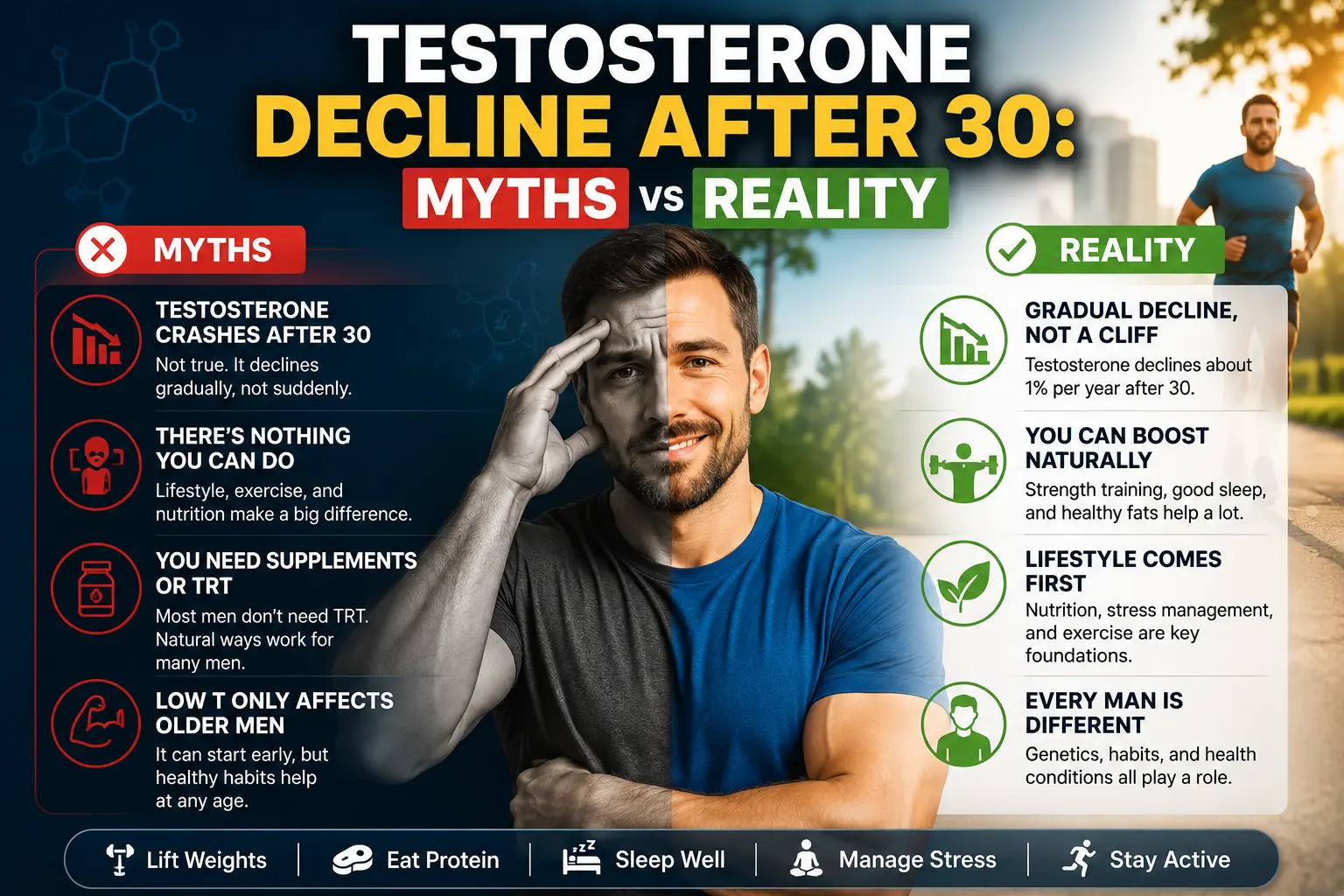
Walk into any gym locker room or scroll through five minutes of fitness content online, and you’ll hear the same claim: testosterone falls off a cliff the moment a man turns 30, and it’s the reason for the fatigue, the belly fat, the low sex drive, everything. Supplement companies have built entire product lines on that fear.
The real picture is both less dramatic and more useful than the panic suggests. Testosterone does decline with age — that part is true — but the rate, the causes, and what actually helps are all more nuanced than “30 and over the hill.” Here’s what the research actually shows.
Myth #1: “Testosterone crashes at 30”
Reality: it’s a slow, gradual slide, not a cliff.
Large clinical guidelines describe a gradual, age-associated decline in total testosterone that begins in a man’s mid-30s and continues at an average rate of roughly 1.6% per year. That’s not a crash — it’s a slow drift. A man with healthy testosterone at 35 isn’t going to wake up hypogonadal at 36; the changes accumulate over decades, and plenty of men in their 50s and 60s still fall well within a normal range.
What actually varies a lot between men isn’t the average rate of decline — it’s individual variability. Two men the same age can have meaningfully different testosterone levels depending on body composition, sleep quality, chronic disease, and genetics, which is a big part of why “normal for your age” isn’t a very useful benchmark on its own.
Myth #2: “Low energy and low libido always mean low T”
Reality: the symptoms overlap heavily with other common conditions — and that overlap is the whole diagnostic problem.
Fatigue, low mood, reduced libido, poor concentration, and reduced muscle mass are the classic list of symptoms attributed to low testosterone. The problem is that this exact symptom cluster also shows up in depression, poor sleep, thyroid issues, and simple overtraining or chronic stress — which is precisely why clinical guidance is cautious about diagnosing “low T” from symptoms alone.
This overlap is well documented in the medical literature: researchers reviewing testosterone decline in aging men have noted that the connection between blood testosterone levels and psychiatric or physical symptoms isn’t clear-cut, since several other hormonal and lifestyle factors are usually involved at the same time. In practice, this means two things: symptoms alone aren’t a diagnosis, and a man who feels “off” shouldn’t assume testosterone is the culprit without an actual blood test — and ideally a conversation about sleep, mood, and stress too.
Myth #3: “You need testosterone therapy if your number is anything less than optimal”
Reality: treatment is generally reserved for men who are both symptomatic and consistently below a defined threshold — not for chasing a higher number.
Major medical bodies, including the Endocrine Society and the American Urological Association, generally support considering testosterone therapy in symptomatic men with reliably low morning testosterone confirmed on repeat testing — commonly cited around the 300 ng/dL (10.4 nmol/L) mark, though reference ranges vary somewhat by guideline and lab. That’s a meaningfully different bar than “my number is on the lower end of normal, so I should start therapy.”
The American College of Physicians has gone further, recommending that clinicians reassess symptoms periodically after starting treatment and actually discontinue testosterone therapy in men whose sexual function doesn’t improve — a reminder that testosterone therapy is meant to treat a specific, measurable deficiency with a specific symptom response, not to serve as a general-purpose energy or mood booster.
Myth #4: “Testosterone therapy is dangerous for your heart”
Reality: this was a real, serious concern for years — and the largest trial to date says otherwise, with some caveats.
This myth actually has a legitimate history behind it. Earlier observational studies raised alarm about a possible link between testosterone therapy and heart attacks or strokes, serious enough that regulators required manufacturers to run a dedicated safety trial.
That trial — TRAVERSE, a large randomized, placebo-controlled study of more than 5,200 men aged 45 to 80 with pre-existing cardiovascular disease or high cardiovascular risk — found that testosterone therapy was not associated with a higher rate of major cardiovascular events (heart attack, stroke, or cardiovascular death) compared with placebo. It didn’t increase prostate cancer diagnoses either. Based substantially on this trial, the FDA updated testosterone product labeling in 2025 to remove earlier language suggesting elevated cardiovascular risk.
The caveat worth knowing: TRAVERSE did find a somewhat higher rate of a few specific events in the testosterone group — including non-fatal irregular heart rhythms (arrhythmias), blood clots, and bone fractures. So “safe for the heart” doesn’t mean “risk-free across the board” — it means the specific fear that drove years of caution wasn’t borne out for the main outcome the trial was designed to test. Men with a history of blood clots or arrhythmias are generally advised to discuss that history carefully with a doctor before starting therapy.
Myth #5: “There’s nothing you can do about it besides pills or injections”
Reality: for a large share of men, lifestyle factors move testosterone more than people expect — sometimes enough to matter clinically.
This is probably the most underrated part of the whole conversation. A few of the better-supported levers:
Body weight. Excess body fat — particularly visceral fat — actively suppresses testosterone production through a few overlapping mechanisms: it increases conversion of testosterone to estrogen, raises inflammation, and interferes with the hormonal signaling that tells the body to produce testosterone in the first place. Research has found that obese men face a substantially higher risk of low testosterone compared with normal-weight men, and multiple studies show that meaningful weight loss — often starting with basic dietary changes — is associated with measurable increases in testosterone. This is one of the few “modifiable” factors with genuinely strong evidence behind it.
Sleep, specifically sleep apnea. Chronic short sleep and, more specifically, obstructive sleep apnea are linked to lower testosterone levels, likely through disrupted deep sleep and intermittent oxygen deprivation overnight. This matters because sleep apnea is common in men who are overweight — meaning weight and sleep often compound each other rather than acting as separate, independent problems.
Exercise, especially resistance and vigorous aerobic training. Strength training involving large muscle groups has been associated with measurable increases in testosterone, and in overweight or obese men specifically, a structured aerobic exercise program has been shown to raise circulating testosterone levels over as little as 12 weeks — even before major weight loss occurs.
None of this means lifestyle changes can substitute for medical treatment in a man with confirmed hypogonadism. But for the much larger group of men whose testosterone is “lower than they’d like” without meeting a clinical threshold, these are the interventions with the most actual evidence behind them — considerably more than most over-the-counter “testosterone boosting” supplements can currently claim.
The Bottom Line
Testosterone decline after 30 is real, but it’s gradual, highly individual, and easy to misdiagnose from symptoms alone. A tired, unmotivated 35-year-old is far more likely to be dealing with poor sleep, stress, or extra body weight than a hormonal emergency — and the fix for that overlaps heavily with what actually moves testosterone anyway: better sleep, resistance training, and a healthier body composition.
If symptoms are persistent and significant, the right next step isn’t a supplement stack — it’s a blood test, ideally more than one, taken in the morning when levels are highest, and a conversation with a doctor about what the number actually means in the context of how you’re feeling. Testosterone therapy has a real, evidence-backed place in medicine for men who meet the criteria — it’s just a more targeted tool than the internet tends to suggest.