Heart disease kills one man in the United States roughly every 34 seconds. It remains the single leading cause of death for men, yet half of men who die suddenly from coronary heart disease never had a single symptom beforehand. That statistic alone should change how you think about your heart. But a major 2026 study adds something even more urgent: for most men, the real story doesn’t start in your 50s or 60s. It starts in your mid-30s, quietly, years before anyone would think to check.
This article breaks down what that new research actually found, the early warning signs men consistently ignore, and what genuinely reduces your risk — not vague advice, but specifics you can act on.
The New Finding: Your Heart Risk Clock Starts Earlier Than You Think
For years, doctors cited a “10-year gap” between men and women — the idea that men develop heart disease about a decade before women, on average. A large 2026 study out of Northwestern University, published in the Journal of the American Heart Association, put that number to a real test using the CARDIA study, which tracked more than 5,100 adults from ages 18–30 in the mid-1980s all the way through 2020.
The findings were striking. Men and women tracked almost identically through their early 30s. Then, right around age 35, the curves split apart. Men’s cardiovascular risk began climbing noticeably faster from that point forward. By the numbers: men reached a 5% cumulative incidence of cardiovascular disease around age 50.5, compared to 57.5 for women — a seven-year gap. For coronary heart disease specifically, the gap was even bigger: men crossed a 2% incidence threshold more than a decade before women did.
Here’s the part that matters most for how you think about your own health. Study co-author Dr. Sadiya Khan put it plainly: heart disease doesn’t happen overnight, it develops over years, and it can start in your 30s or 40s even if you feel completely fine at the time. Your risk clock can be running well before any symptom ever shows up.
Why the Mid-30s Specifically?
Researchers accounted for the usual suspects — blood pressure, cholesterol, blood sugar, smoking, physical activity, and body weight — and even after adjusting for all of them, the gap between men and women narrowed but didn’t disappear. That suggests something beyond simple lifestyle factors is driving the earlier divergence in men, though the exact biological mechanism isn’t fully settled yet.
One clue comes from the other side of the comparison. Researchers believe estrogen offers women some cardiovascular protection during their reproductive years, which delays their risk curve — until perimenopause and menopause, when that protection fades and women’s risk accelerates to catch up. Men never had that early protection to begin with, which may explain why their risk curve starts climbing sooner and more steadily.
The practical takeaway isn’t really about the biology, though — it’s about screening. Updated American Heart Association risk equations now let doctors estimate cardiovascular risk starting at age 30, instead of the previous starting point of 40. If you’re a man in your 30s who has never had a real cardiovascular risk conversation with a doctor, this new data is a legitimate reason to start one.
The Warning Signs Most Men Ignore
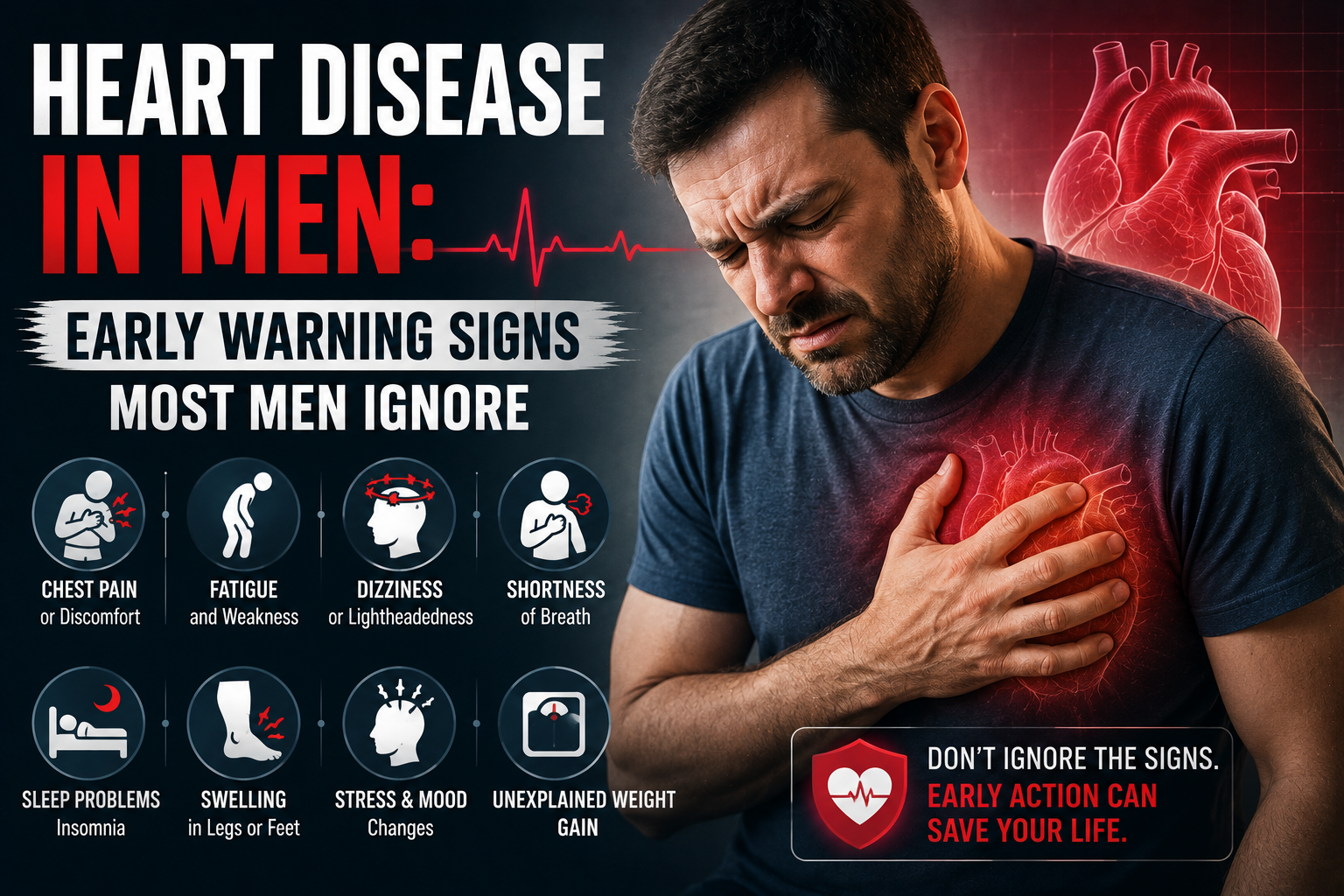
Heart disease “rarely happens without warning” — but the warnings are frequently subtle, easy to explain away, and don’t look like the dramatic movie-scene heart attack most people picture. Here’s what actually tends to show up early:
Chest discomfort that doesn’t feel “normal.” This is often described as pressure, tightness, or heaviness rather than sharp, stabbing pain. It may come and go, or linger for several minutes, and it can radiate to the arm, shoulder, back, neck, or jaw. Men frequently dismiss this as muscle strain or stress.
Unusual fatigue. Persistent tiredness that isn’t explained by poor sleep or a hard week at work can be an early cardiovascular signal, particularly when it’s a genuine change from your normal baseline.
Shortness of breath after moderate exertion. Struggling to catch your breath doing something that never used to wind you — a flight of stairs, a short walk — is one of the most commonly overlooked early indicators.
Heart palpitations or a racing, skipping heartbeat. An irregular or unusually fast heartbeat, especially at rest, deserves attention rather than a shrug.
Dizziness or lightheadedness. Especially when it’s new, recurring, or happens alongside any of the other symptoms on this list.
Swelling in the legs, ankles, or feet. This can indicate the heart isn’t pumping efficiently, causing fluid to back up in the lower body.
Unexplained nausea or cold sweat. These are less intuitive as “heart” symptoms, which is exactly why they get missed or attributed to something else entirely, like a stomach bug.
Erectile dysfunction. This one surprises a lot of men, but the connection is well established: since erections depend on healthy blood flow, new or worsening ED can be an early warning sign of cardiovascular disease, sometimes appearing years before other symptoms. Multiple health organizations, including Harvard Health, specifically flag this as a signal worth taking seriously rather than treating as a separate, unrelated issue.
The unifying problem with this list is that almost every item on it can be explained away. Chest tightness becomes “probably just stress.” Fatigue becomes “I’ve just been busy.” Shortness of breath becomes “I’m out of shape.” Individually, any one of these might genuinely be nothing. But if several are new, persistent, or getting worse, that pattern is worth a real conversation with a doctor — not another few weeks of waiting to see if it passes.
Why Men Specifically Tend to Ignore These Signs
There’s a well-documented cultural pattern here, and it overlaps with a broader issue in men’s health: many men are conditioned to “push through” physical discomfort rather than treat it as information worth acting on. The same instinct that keeps men from seeking mental health support — minimizing symptoms, treating vulnerability as weakness — shows up here too, except the stakes are a heart attack instead of a difficult conversation. If that pattern sounds familiar, it’s the same one we explored in depth in Men’s Mental Health: Why the Stigma Around Seeking Help Still Persists.
It’s also worth noting that heart attack symptoms in men don’t always match the “classic” version most people picture. While men are somewhat more likely than women to experience textbook chest pain, symptoms can still vary meaningfully between individuals, and relying on a single mental checklist — “if it’s not crushing chest pain, it’s not my heart” — is exactly the kind of thinking that delays care.
Risk Factors Worth Knowing
Some cardiovascular risk factors are outside your control — age, family history of early heart disease, and certain genetic factors among them. But several of the biggest contributors are modifiable, and knowing your actual numbers matters more than guessing:
High blood pressure affects roughly 1 in 3 men and is often called the “silent killer” specifically because it typically has no symptoms at all. The target is below 120/80 mmHg.
Cholesterol matters in both directions — LDL (“bad” cholesterol) should stay below 100 mg/dL, while HDL (“good” cholesterol) should stay above 40 mg/dL.
Smoking roughly doubles heart attack risk, but quitting cuts that added risk by about half within just one year — one of the fastest-acting risk reductions available.
Diabetes can double to quadruple heart disease risk, making blood sugar control (targeting an A1C below 7%) a genuinely high-leverage health priority, not just a diabetes-specific concern.
Weight and waist size matter beyond a simple BMI number — a waist circumference over 40 inches specifically signals elevated cardiovascular risk in men, even independent of overall body weight.
A sedentary lifestyle roughly doubles heart disease risk on its own, making regular physical activity one of the single most impactful, fully modifiable factors on this entire list.
Beyond the classic risk factors, some cardiologists also point to broader modern lifestyle shifts — less sleep, more chronic stress, less social connection, and greater exposure to environmental pollutants — as contributing to the trend of earlier-onset heart disease, even though these factors are harder to measure precisely than blood pressure or cholesterol. Sleep in particular deserves real attention here, since poor sleep quality directly affects blood pressure and inflammation over time — our guide on how much sleep men really need is worth reading alongside this one.
What to Actually Do With This Information
If you’re in your 30s or 40s and have never discussed cardiovascular risk with a doctor, that conversation is overdue. Given that updated screening guidelines now start at age 30, and given what the CARDIA data shows about how early men’s risk begins climbing, waiting until your 40s or 50s to start paying attention means missing the exact window where prevention is most effective.
Know your actual numbers, not just how you feel. Blood pressure and cholesterol are frequently symptomless until they’ve already caused real damage. A basic screening panel gives you real data instead of a guess based on how you feel day to day.
Take new or worsening erectile dysfunction seriously as a potential health signal, not just a standalone issue — bring it up with a doctor rather than treating it as unrelated to your broader cardiovascular health.
Don’t wait out a cluster of symptoms. One tired afternoon means nothing. Persistent fatigue, breathlessness on mild exertion, and chest tightness showing up together, especially if new, is a different story — and it’s worth an actual medical evaluation rather than self-diagnosis.
Treat modifiable risk factors as genuinely modifiable. Quitting smoking, walking regularly, and managing blood sugar aren’t abstract “someday” goals — each one produces a measurable reduction in risk, and the earlier you start, the more years of benefit you get.
Final Thoughts
The instinct to power through physical discomfort — to assume chest tightness is just stress, or that fatigue is just a busy season — is exactly the instinct that a major 2026 study suggests men should start questioning earlier than they typically do. Heart disease isn’t an old man’s disease that suddenly appears in your 60s. According to the latest research, the risk curve is already climbing by your mid-30s, quietly, well before most men think to pay attention.
None of this requires panic. It requires a shift in when you start paying attention, and a willingness to treat persistent, unexplained symptoms as information rather than inconvenience. Half of men who die suddenly of coronary heart disease had no prior symptoms — which makes proactive screening, not waiting for a warning sign, the single most reliable strategy available.
Frequently Asked Questions
At what age should men start worrying about heart disease?
According to 2026 research from Northwestern University, men’s cardiovascular risk begins climbing noticeably around age 35 — years earlier than previously assumed. Updated American Heart Association guidelines now recommend cardiovascular risk screening starting at age 30, rather than the previous benchmark of 40.
What are the earliest warning signs of heart disease in men?
Common early signs include chest pressure or tightness (not always sharp pain), unusual fatigue, shortness of breath after mild exertion, heart palpitations, dizziness, swelling in the legs or feet, and new or worsening erectile dysfunction. Individually these can seem minor, but a persistent cluster of symptoms warrants medical evaluation.
Can erectile dysfunction really be a sign of heart disease?
Yes. Since erections depend on healthy blood flow, new or worsening ED can be an early indicator of cardiovascular disease, sometimes appearing before other more recognizable symptoms. Health organizations including Harvard Health specifically recommend treating new ED as a potential cardiovascular signal worth discussing with a doctor.
Why do men develop heart disease earlier than women?
Researchers believe estrogen provides women some cardiovascular protection during their reproductive years, delaying their risk curve until perimenopause and menopause, when that protection fades. Men don’t have this early protective effect, which may explain why their cardiovascular risk begins climbing earlier and more steadily, starting around the mid-30s.
What lifestyle changes have the biggest impact on heart disease risk?
Quitting smoking cuts added risk roughly in half within one year. Regular physical activity addresses the roughly doubled risk associated with a sedentary lifestyle. Managing blood pressure, cholesterol, and blood sugar through diet, exercise, and medical care when needed all meaningfully reduce long-term cardiovascular risk.
Disclaimer: This article is for general informational purposes and is not a substitute for professional medical advice. If you’re experiencing chest pain, sudden shortness of breath, or other signs of a possible heart attack, seek emergency medical care immediately. Consult a healthcare provider to assess your individual cardiovascular risk.
Related reads: