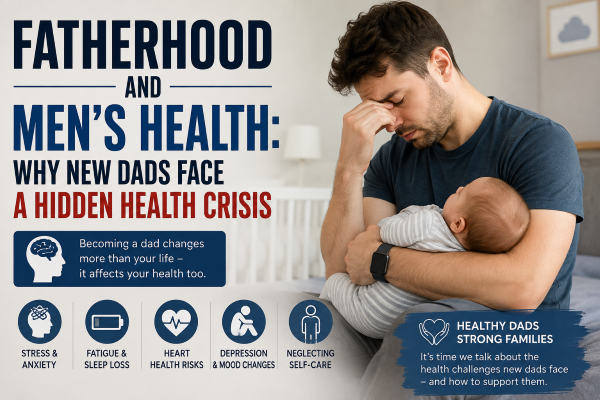
Everyone prepares for what happens to a mother’s body and mind after a baby arrives. Almost no one prepares for what happens to the father’s. There’s no equivalent checklist. There’s no widely known screening tool at pediatrician visits. And there’s very little cultural permission for a new dad to say he’s struggling. This gap between fatherhood and men’s health is exactly why so many new dads suffer quietly, without ever getting help.
Yet the data on fatherhood and men’s health tells a clear story. Something real is happening to a large share of new fathers, and it’s happening largely unnoticed. This article looks at what the research actually shows about the health toll of new fatherhood — mental health, sleep, relationships, and physical health — and what genuinely helps.
The Numbers: Why Fatherhood and Men’s Health Rarely Get Discussed Together
[Image suggestion: Simple stat graphic showing 1 in 10 fathers affected by postpartum depression — alt text: “paternal postpartum depression statistics”]
Depending on which screening criteria and timeframe researchers use, somewhere between 8% and 25% of new fathers experience clinically significant depression in the year following a child’s birth. Peer-reviewed meta-analyses converge on roughly 8–10% for postpartum depression specifically. Rates peak twice — once during the first trimester of the partner’s pregnancy (around 13.6%), and again between three and six months after birth (around 9.2%). Beyond depression alone, up to 18% of new fathers experience clinically significant generalized anxiety, OCD, or PTSD symptoms during that same first year.
The strongest known predictor isn’t genetics or personal history. It’s what’s happening with the mother. When a father’s partner experiences postpartum depression herself, his own risk of depression rises sharply. Studies report a 24% to 50% increased likelihood, with some sources placing the co-occurrence rate as high as 50%. This has led researchers to argue that postpartum mental health assessment should treat the family as the unit of care, not just the mother in isolation.
The Delayed Crisis Nobody Talks About
Here’s the finding that should genuinely change how we think about new fatherhood: the mental health hit doesn’t arrive when most people expect it to.
A massive 2026 study in JAMA Network Open analyzed psychiatric records from over one million fathers in Sweden between 2003 and 2021. It found something counterintuitive. Diagnoses for depression and stress-related disorders actually decreased during the partner’s pregnancy and the earliest months after birth — often described as a kind of parental “honeymoon phase.” Then, roughly one year after the child’s birth, psychiatric diagnoses among fathers spiked by more than 30% compared to pre-pregnancy levels.
The researchers point to cumulative pressure as the likely driver. Sleep deprivation, financial strain, and shifting relationship dynamics don’t resolve after the initial newborn period. Instead, they compound quietly over months, arriving as a delayed crisis rather than an immediate one. This timing gap matters enormously in practical terms. Most postpartum support, screening, and check-ins concentrate in the first weeks after birth. If the real psychiatric risk for fathers peaks around the one-year mark, most existing support systems are looking in the wrong window entirely.
Why Paternal Depression Looks Different — and Gets Missed
One central reason paternal postnatal depression (PPND) goes underdiagnosed: it often doesn’t look like depression at all, at least not the way most people picture it. Rather than sadness, guilt, and tearfulness — more commonly associated with maternal postpartum depression — PPND in fathers tends to show up as irritability, withdrawal, increased substance use, and externalizing behavior. Anger and disconnection replace visible sorrow.
This distinction has real clinical consequences. Researchers originally validated standard screening tools like the Edinburgh Postnatal Depression Scale (EPDS) on women. Later studies show these tools also work for detecting depression in fathers, but they generally require different score cutoffs to catch it — cutoffs that most clinical settings don’t consistently apply. In practice, this means a father can be struggling significantly and still screen as “fine” on a tool that wasn’t built with his symptom pattern in mind.
Combine this with a near-total lack of routine paternal mental health screening in most healthcare systems, and the result is stark: clinicians officially record only around 10% of paternal depression cases. The vast majority of affected fathers go unrecognized and unsupported.
What This Actually Does to Families
Untreated paternal depression isn’t a private, contained problem. The research is clear that it ripples outward. Documented downstream effects include increased hostility and conflict with a partner, feelings of resentment toward the baby, and harsher parenting and discipline patterns. It also reduces positive engagement with the infant — less warmth, playfulness, and physical affection — which can measurably delay father-infant attachment.
Untreated paternal depression is also associated with worse behavioral, emotional, and conduct outcomes in children later on. It increases the risk of broader Adverse Childhood Experiences too.
We’re not saying this to induce guilt. Quite the opposite — it’s the strongest possible case for taking a struggling new father’s mental health seriously as early as possible, since the benefit extends well beyond the father himself.
The Physical Side of Fatherhood and Men’s Health: Sleep, Body, and the Stuff Nobody Mentions
[Image suggestion: A tired father drinking coffee at dawn while holding a baby monitor — alt text: “new father sleep deprivation health”]
The mental health data gets most of the research attention. But the physical toll of new fatherhood is just as real, even if it’s less rigorously studied.
Chronic sleep deprivation in the first year directly worsens mood regulation, cognitive function, and the ability to cope with stress. It often happens by choice — many fathers “tough it out” rather than sharing night duties — and this creates a compounding cycle with the mental health risks described above. If you’re navigating this stretch, our guide on how much sleep men really need is worth revisiting specifically during this period. Sleep debt tends to accumulate quietly over months rather than announcing itself all at once.
New fathers also commonly report weight gain, reduced exercise, and general self-neglect. This often happens as a straightforward side effect of time and energy being redirected entirely toward the baby and partner, with the father’s own basic health maintenance quietly dropping to the bottom of the list. No one typically flags any of this. Partners focus on recovery and the baby, and culture primes fathers themselves to treat their own needs as secondary, or simply not worth mentioning.
Signs Worth Paying Attention To
Because paternal depression often doesn’t look like textbook depression, it’s worth knowing the specific pattern to watch for, in yourself or a partner:
- Increased irritability, anger, or a noticeably shorter fuse than usual
- Withdrawal from the partner, baby, friends, or previously enjoyable activities
- Increased alcohol use or other substance use as a coping mechanism
- Persistent exhaustion that doesn’t improve even with occasional extra sleep
- A sense of numbness or disconnection from the baby, rather than overwhelming sadness
- Resentment toward the baby, partner, or the general situation, especially if it feels hard to admit
If several of these have been consistently present for more than two weeks — particularly anywhere from a few months to a year after the birth — treat that as a legitimate signal. Don’t wait it out silently.
Practical Steps: What Actually Helps New Dads
Fatherhood and men’s health don’t have to stay disconnected. A few evidence-backed steps genuinely make a difference.
Get Screened, Even If No One Offers It to You
Routine paternal screening is still rare in most healthcare settings. The most reliable path is often to ask directly. Tell your or your partner’s healthcare provider you’d like to be screened, or complete a validated tool like the EPDS yourself and bring the results to a doctor.
Watch the One-Year Mark, Not Just the Newborn Phase
Given what the 2026 Swedish cohort study found, pay close attention to your own mental state around and after your child’s first birthday. Most fathers, and the people around them, assume this period is already “past the hard part.”
Address Sleep Debt Directly Rather Than Normalizing It
Share night duties, even imperfectly. Treat sleep as a genuine health priority rather than a luxury you’ve earned the right to sacrifice. This meaningfully reduces the compounding stress that tends to build across the first year.
Consider Group-Based Support Specifically for Fathers
Programs modeled on peer support for new dads let fathers validate their experiences among others going through the same transition. Hospital systems increasingly offer these programs, and researchers specifically cite them as effective for helping fathers develop emotional management and parenting skills in a less isolating format than one-on-one therapy alone.
Take the Stigma Conversation Seriously
Much of what keeps new fathers from acknowledging PPND overlaps directly with the broader pattern of men avoiding mental health support. It’s the same “tough it out” instinct, the same fear that admitting struggle looks like weakness. If that pattern sounds familiar, read our broader breakdown of men’s mental health stigma, since many of the same barriers and solutions apply directly here.
Support Your Partner and Yourself Together
If your partner is struggling too, treat it as a shared, connected situation. Paternal and maternal postpartum depression correlate strongly. Supporting your partner’s mental health and addressing your own aren’t competing priorities — they’re deeply linked, and improvement in one often supports the other.
Final Thoughts on Fatherhood and Men’s Health
Fatherhood and men’s health don’t get talked about together nearly often enough. The data suggests that gap has real consequences — for fathers, for their partners, and for their children. The crisis, when it comes, often doesn’t arrive in the dramatic, immediately recognizable way people expect. It builds quietly. It peaks around the one-year mark rather than the newborn weeks. And it shows up as irritability and withdrawal rather than obvious sadness — which is exactly why it goes unnoticed as often as it does.
If you’re a new father who recognizes any of this, or you love someone who might be, here’s the single most useful thing you can do: stop treating this as something that only happens to mothers. It doesn’t. Naming that clearly is often the first real step toward getting through it.
Frequently Asked Questions
How common is depression in new fathers?
Peer-reviewed research places paternal postpartum depression at roughly 8–10% of new fathers, with some estimates going as high as 25% depending on screening criteria and timeframe. That rate roughly doubles to 40–50% when the father’s partner is also experiencing postpartum depression.
When are new fathers most at risk for depression?
Research points to two distinct risk windows: during the first trimester of the partner’s pregnancy, and again — often more significantly — around one year after the child’s birth, according to a large 2026 study of over one million Swedish fathers. Most postpartum support concentrates on the earliest months, so clinicians and families frequently miss this delayed peak.
Why does depression in fathers often go unnoticed?
Paternal depression frequently presents as irritability, withdrawal, and increased substance use rather than the sadness more commonly associated with depression. Researchers didn’t originally design standard screening tools with this symptom pattern in mind. Combined with limited routine screening for fathers, clinicians officially record only an estimated 10% of cases.
Does a father’s mental health actually affect the baby?
Yes. Research links untreated paternal depression to reduced positive engagement and warmth with the infant, delayed attachment, harsher parenting patterns, and increased risk of behavioral and emotional difficulties in children later on. This makes it a family health issue, not just an individual one.
What should I do if I think I have paternal postnatal depression?
Consider completing a validated screening tool like the Edinburgh Postnatal Depression Scale and bringing the results to a healthcare provider, since routine screening for fathers still isn’t standard practice in most settings. Peer support groups specifically for new fathers, along with directly addressing sleep debt, are both evidence-backed starting points.
Disclaimer: This article is for general informational purposes and is not a substitute for professional medical or mental health advice. If you’re a new father struggling with your mental health, Postpartum Support International offers a dedicated helpline for fathers and partners at 1-800-944-4773. If you or someone you know is experiencing thoughts of self-harm, please seek immediate professional help.
Related reads: