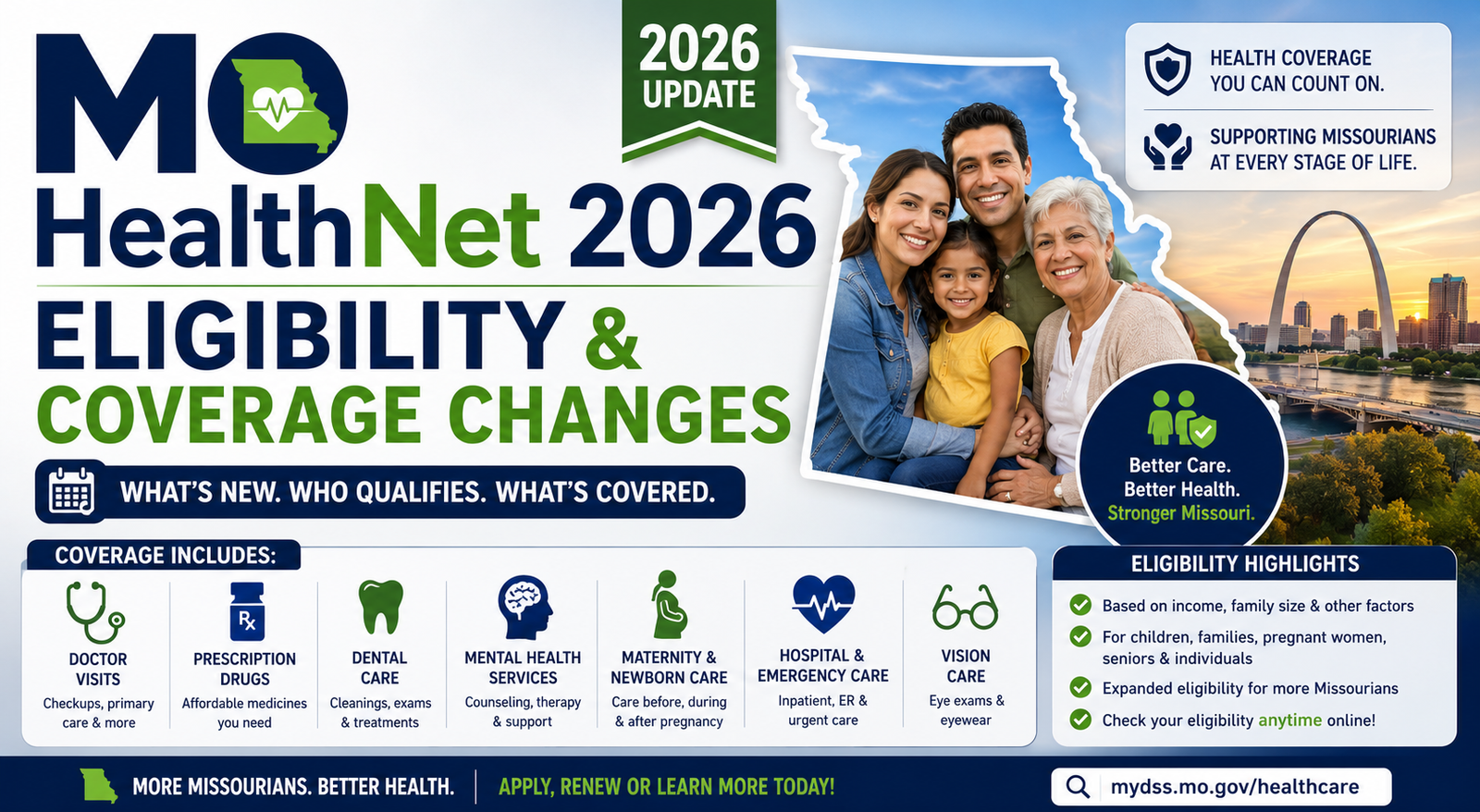
Missouri’s Medicaid program is called MO HealthNet, and in 2026, it’s going through some of the most significant changes it’s seen in years. Whether you’re currently enrolled, thinking about applying, or trying to understand what recent policy shifts mean for your family’s healthcare access, this guide breaks down everything you need to know — eligibility rules, income limits, the application process, and the coverage cuts that took effect this year. For a broader look at health resources across the state beyond insurance coverage, see our complete guide to MO Health and Wellness.
What Is MO HealthNet?
MO HealthNet is Missouri’s version of Medicaid, administered by the Family Support Division (FSD) under the Missouri Department of Social Services. It provides medical coverage to residents who meet specific eligibility requirements, with a mission built around several core goals: promoting good health, preventing illness and premature death, correcting or limiting disability, treating illness, and providing rehabilitation services to people with disabilities.
The scale of the program is significant. As of 2026, MO HealthNet covers more than 1.3 million Missourians, including roughly 500,000 children — meaning it touches a substantial share of families across the state, from major cities to small farm communities.
To qualify for MO HealthNet in general terms, you need to be a Missouri resident, a U.S. national, citizen, permanent resident, or legal alien, in need of health care assistance, and fall within the program’s income guidelines for your household size and category.
Who Qualifies? A Breakdown by Category
MO HealthNet isn’t one single eligibility pathway — it’s a collection of programs, each with its own income limits based on age, disability status, and family situation. Here’s how the major categories break down for 2026:
Expansion Adults (ages 19–64): Since Missouri expanded Medicaid through Amendment 2 in November 2020, effective July 1, 2021, adults in this age range qualify at 138% of the Federal Poverty Level, which works out to roughly $1,799 per month for a single-person household. There’s no asset test for this group, and eligibility is based on Modified Adjusted Gross Income (MAGI) rules rather than a strict asset calculation.
Children (ages 1–18): Standard MO HealthNet coverage for children uses a tiered structure — children ages 1 to 5 qualify at 155% of the Federal Poverty Level, and children ages 6 to 18 qualify at the same 155% threshold. In practical terms, this generally translates to family income up to roughly $2,021 per month for a one-person reference household, adjusted upward for larger families.
Show Me Healthy Kids (CHIP): For children in families whose income exceeds standard MO HealthNet limits, Missouri’s Children’s Health Insurance Program extends coverage up to 300% of the Federal Poverty Level — a considerably higher ceiling designed to catch families who earn too much for standard Medicaid but still need help affording coverage.
Pregnant women: Coverage extends to those with income up to approximately 201% of the Federal Poverty Level, or roughly $2,621 per month when calculated as a household of two. Importantly, this coverage doesn’t end at delivery — it continues for a full 12 months postpartum, a policy specifically designed to support maternal health in the months after childbirth.
Aged, blind, and disabled individuals: This category has notably stricter limits than the expansion adult pathway. The income limit sits at $1,109 per month for a single individual, or a combined $1,499 per month for married couples, where both spouses’ income is counted together. This group also faces an asset limit of $6,068.80 for a single applicant, or $12,137.55 for a married couple.
Nursing home and long-term care applicants: For a single Nursing Home Medicaid applicant in 2026, the rules work differently — nearly all available income must go toward the cost of nursing home care, with only a few exceptions like a $50/month personal needs allowance, Medicare premiums, and potentially a needs allowance for a non-applicant spouse. Assets must stay under $6,068.80, and applicants must require a nursing-home level of care to qualify.
It’s worth noting: not meeting every criterion listed above doesn’t automatically mean you’re ineligible. Missouri’s eligibility rules include exceptions — for example, if your monthly income is technically too high but your medical costs bring your effective income within the limit, you may still qualify. If you’re unsure where you stand, applying or using an official eligibility screening tool is the most reliable way to find out.
Major Coverage Changes That Took Effect in 2026
This is the part of the MO HealthNet story that’s changing right now, and it directly affects current beneficiaries, not just new applicants.
Complementary and alternative pain management services cut. Effective July 1, 2026, MO HealthNet stopped paying for acupuncture, chiropractic, and physical therapy services that had previously been covered under the Complementary Health and Alternative to Chronic Pain Management program. Any visits for these services after June 30, 2026 are no longer covered. This change applies statewide, to all MO HealthNet participants, including those enrolled through MO HealthNet Managed Care plans.
Chiropractic services eliminated entirely. Separately from the pain-management program cut above, MO HealthNet also stopped covering visits to licensed chiropractors altogether, effective the same July 1, 2026 date. If you’ve relied on MO HealthNet to cover chiropractic care, you’ll need to look into alternative payment options or providers going forward.
If these changes affect you directly, MO HealthNet Constituent Services can be reached at 1-800-392-2161 (TTY 711) for questions about how the cuts apply to your specific situation.
What’s Coming in 2027: Work Requirements and More Frequent Eligibility Checks
The 2026 coverage cuts aren’t the only changes Missouri Medicaid recipients need to prepare for. Under the federal “One Big Beautiful Bill Act” (OBBBA), which introduces roughly $1 trillion in Medicaid funding cuts nationally over ten years, Missouri is expected to implement new work requirements for expansion adults.
Specifically, adults ages 19–64 enrolled through the expansion pathway will likely need to complete 80 hours of work, job training, or qualifying activity per month starting in 2027, with tracking expected to begin as early as December 2026 and enforcement following in January 2027. Alongside this, MO HealthNet is also moving toward more frequent eligibility checks — reportedly every six months rather than the previous annual cycle — meaning beneficiaries will need to recertify their eligibility more often to avoid losing coverage.
It’s worth flagging that some of these federal changes are still facing legal challenges at both the state and federal level, so the exact rollout and enforcement timeline isn’t entirely settled. Nursing Home Medicaid coverage is expected to remain largely protected from these cuts, while Home and Community Based Services (HCBS) are considered more likely to be affected as funding changes take hold.
How to Apply for MO HealthNet
If you think you might qualify, here’s what the application process typically involves:
Ways to apply: You can apply for MO HealthNet online through the myDSS portal, by phone, in person at a local Family Support Division office, or by mail.
Documents you’ll typically need:
- Identification: A driver’s license, state ID, birth certificate, or Social Security card
- Income verification: Recent pay stubs (usually covering the last 30 days), W-2s, tax returns, or documentation of SSI or unemployment benefits
- Proof of Missouri residency: A utility bill, lease agreement, or mail showing your current Missouri address
- Household information: Names, ages, relationships, and Social Security numbers for everyone in your household
- Medical documentation: Where relevant, particularly for disability-based applications
A practical note: Given the upcoming eligibility changes and stricter recertification schedule expected to begin in late 2026, applying sooner rather than later — and keeping your documentation organized for future renewals — is a genuinely sensible strategy if you think you may qualify.
What Services Does MO HealthNet Cover?
Beyond the specific cuts mentioned above, MO HealthNet’s medical services generally include outpatient hospital services (including diagnostic services through hospital outpatient departments or clinics), laboratory and x-ray services when prescribed by a physician, nursing home services at facilities meeting state licensing and federal standards, and physician’s services whether provided in an office, home, hospital, nursing home, or elsewhere. Personal care and adult day health care services are also available in the home as an alternative to institutional care for those who qualify.
For older adults specifically, the Program of All-Inclusive Care for the Elderly (PACE) is jointly administered by MO HealthNet and Medicare, providing comprehensive medical, social, recreational, and wellness services with a specific goal: helping older adults continue living safely in their own homes rather than moving into nursing facilities.
Missouri also offers a Ticket to Work program for individuals with disabilities who earn too much to qualify for standard MO HealthNet but still need help covering healthcare costs while participating in employment.
If You’re Losing Coverage for Chiropractic, Acupuncture, or Physical Therapy
If you relied on MO HealthNet for any of the services cut in July 2026, it’s worth exploring a few alternative paths:
- Check if your condition qualifies for coverage through a different pathway. Some physical therapy needs tied to specific diagnoses or post-surgical recovery may still be covered under different program rules — this is worth confirming directly with MO HealthNet Constituent Services rather than assuming complete exclusion.
- Ask providers about sliding-scale or reduced-fee options. Many chiropractors and physical therapy clinics, particularly community health centers, offer income-based payment plans for patients who’ve lost insurance coverage for these services.
- Look into whether your condition might qualify for coverage through Medicare, if you’re dually eligible, since Medicare’s coverage rules for these services differ from MO HealthNet’s.
Final Thoughts
MO HealthNet remains a critical resource for well over a million Missourians, but 2026 has brought real, tangible changes — from the July coverage cuts affecting chiropractic, acupuncture, and physical therapy, to the work requirements and more frequent eligibility checks expected to begin rolling out toward the end of the year and into 2027. If you’re currently enrolled, the most important thing you can do right now is stay informed about your specific eligibility category and watch for renewal notices, since missing a recertification deadline under the new, more frequent review cycle could mean an unexpected gap in coverage.
If you’re not yet enrolled but think you might qualify, applying sooner rather than later — before stricter requirements potentially take effect — is a reasonable, proactive step. And if you have questions specific to your situation, MO HealthNet Constituent Services at 1-800-392-2161 remains the most reliable source for personalized guidance.
Frequently Asked Questions
What is the income limit for MO HealthNet in 2026?
It depends on your category. Expansion adults (ages 19–64) qualify at 138% of the Federal Poverty Level, roughly $1,799/month for a single person. Aged, blind, and disabled individuals face a stricter limit of $1,109/month. Children and pregnant women have higher thresholds, up to 155% and 201% of the Federal Poverty Level respectively.
Does MO HealthNet still cover physical therapy?
As of July 1, 2026, MO HealthNet stopped covering physical therapy services specifically under the Complementary Health and Alternative to Chronic Pain Management program. Some physical therapy tied to different diagnoses or medical pathways may still be covered — check directly with MO HealthNet Constituent Services to confirm your specific situation.
Will I need to work to keep my MO HealthNet coverage?
Work requirements for expansion adults (ages 19–64) are expected to begin tracking around December 2026, with enforcement following in January 2027, requiring roughly 80 hours per month of work or qualifying activity. This is tied to federal policy changes under the OBBBA and may still be subject to legal challenges.
How often will I need to renew my MO HealthNet eligibility?
Eligibility checks are expected to move to a six-month cycle rather than the previous annual review, starting around December 2026. Keeping your documentation current and responding promptly to renewal notices will be more important than ever under this schedule.
How do I apply for MO HealthNet?
You can apply online through the myDSS portal, by phone, in person at a Family Support Division office, or by mail. You’ll typically need identification, income verification, proof of Missouri residency, and household information for everyone applying.
Note: Eligibility figures, income limits, and policy details referenced in this article reflect publicly available information as of mid-2026. Medicaid rules and federal policy under the OBBBA continue to evolve and may face ongoing legal challenges — always confirm current details directly with MO HealthNet Constituent Services (1-800-392-2161) or the official mydss.mo.gov website before making healthcare decisions.