Every year, thousands of students clear the AIIMS Paramedical entrance exam hoping to secure a seat in one of India’s most respected medical institutions. But once the excitement of admission settles down, one question comes up again and again: how much does an AIIMS paramedical professional actually earn?
The honest answer is — it depends. Salary at AIIMS varies based on your course, your pay level, your experience, and whether you stay in the government sector or move to private healthcare. This guide breaks down everything in simple terms, from starting pay to long-term earning potential.
AIIMS Paramedical Salary: Quick Overview
<cite index=”2-1″>Paramedical staff at AIIMS can typically expect a salary ranging from ₹30,000 to ₹60,000 per month, depending on the position and experience level.</cite> For fresh graduates just starting out, <cite index=”3-1″>initial salaries generally fall between roughly ₹15,000 and ₹30,000 per month, translating to about ₹3 LPA to ₹6 LPA annually.</cite>
If you’re selected as a permanent AIIMS employee after completing your paramedical degree, your pay is fixed under the government’s official pay matrix — not negotiated like in a private job. This is what makes AIIMS salaries predictable and stable, even if they start out modest compared to top private hospitals.
AIIMS Paramedical Pay Structure: How It Works
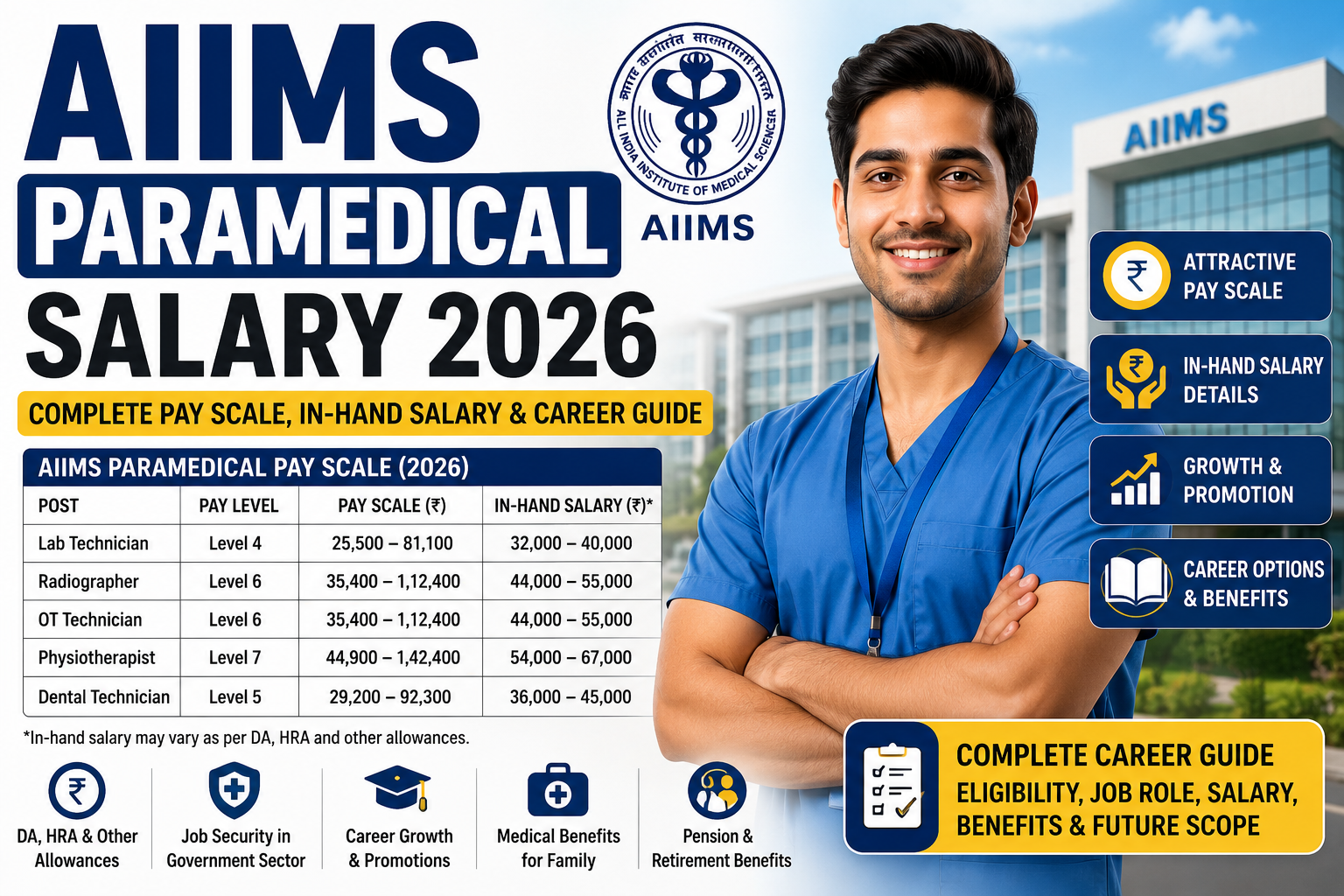
AIIMS paramedical and non-faculty staff are paid under the 7th Central Pay Commission (CPC) framework. <cite index=”17-1″>Group B and Group C non-faculty roles at AIIMS generally fall between Pay Level 2 and Pay Level 7 of the 7th CPC Pay Matrix.</cite> <cite index=”17-1″>Your final salary depends on the basic pay, Dearness Allowance (DA), House Rent Allowance (HRA), and Transport Allowance (TA), along with retirement and health benefits provided by the government.</cite>
Pay Level 6 (Most Common for Paramedical Graduates)
<cite index=”4-1″>If you join AIIMS as a permanent staff member after completing your paramedical degree, you typically fall under the Pay Level 6 matrix, which includes a basic pay of ₹35,400.</cite> <cite index=”4-1″>Once HRA, DA, and TA are added, the total in-hand salary usually works out to approximately ₹55,000 to ₹65,000 per month.</cite> This level generally applies to roles like Radiology Technologists, Lab Technicians, and OT Technicians once they’re confirmed as regular AIIMS staff.
Pay Level 7 (Nursing Officers)
Nursing Officers, who are recruited through the NORCET exam, are placed slightly higher on the pay matrix. <cite index=”9-1″>An AIIMS Nursing Officer’s salary starts at a basic pay of ₹44,900 under Pay Level 7, following the pre-revised Pay Band-2 of ₹9,300–₹34,800 with a Grade Pay of ₹4,600, classified as a Group-B post.</cite> <cite index=”10-1″>After adding DA, HRA, and TA, the gross salary typically rises to around ₹75,000–₹81,000 per month.</cite> <cite index=”11-1″>After standard deductions like NPS and PF, the actual in-hand salary comes to roughly ₹66,000 per month.</cite>
Course-Wise Salary Expectations
Paramedical isn’t a single career — it’s an umbrella covering several distinct courses, and your specialization has a big impact on your long-term earning potential. If you haven’t decided on a course yet, check out our detailed guide on AIIMS Paramedical Courses 2026, which covers eligibility, fees, admission process, and the complete list of available programs.
<cite index=”5-1″>Across India, the average paramedical salary in 2026 typically ranges between ₹2 LPA and ₹6 LPA, depending on your specialization, experience, qualification, and workplace.</cite> <cite index=”5-1″>Entry-level professionals generally earn around ₹15,000 to ₹30,000 per month, while mid-career specialists can earn ₹40,000 to ₹70,000 per month.</cite> <cite index=”5-1″>Diagnostic and therapy-based roles usually pay more than general healthcare assistance roles.</cite>
Here’s a closer look at how this plays out for common courses:
Medical Lab Technology (MLT): <cite index=”5-1″>A fresher with a Diploma in Medical Lab Technology might start around ₹2.8 LPA</cite>, with pay increasing steadily as you gain diagnostic experience.
Operation Theatre (OT) Technology: <cite index=”5-1″>A B.Sc. graduate in Operation Theatre Technology could start at around ₹3.5 LPA</cite>, given the specialized surgical-support skills involved.
Radiology & Imaging Technology: This is one of the higher-paying paramedical specializations. <cite index=”14-1″>A Radiologic Technologist typically starts between ₹4.5 LPA and ₹7 LPA in government setups</cite>, and the ceiling is even higher in specialized private roles. <cite index=”14-1″>MRI/CT Specialists with advanced skills can earn between ₹6 LPA and ₹10 LPA</cite>, while <cite index=”14-1″>Nuclear Medicine Technologists — one of the highest-paying niches in the field — can earn up to ₹13 LPA.</cite> Some radiology graduates even move into corporate roles with global medical equipment companies, <cite index=”14-1″>working as Application Specialists for companies like GE Healthcare, Siemens, or Philips, where packages start around ₹8 LPA and above.</cite>
B.Sc. Nursing: Nursing remains one of the most stable and structured career paths, with clear promotion stages from Staff Nurse Grade-II onward within the AIIMS system itself.
Career Growth: How Salary Increases Over Time
One of the biggest advantages of working at AIIMS is the clear, structured promotion path — something private hospitals rarely offer with the same transparency.
For Nursing Officers, <cite index=”11-1″>the typical progression moves from Staff Nurse Grade-II to Staff Nurse Grade-I, then to Assistant Nursing Superintendent, Deputy Nursing Superintendent, and eventually Chief Nursing Superintendent.</cite> Each promotion comes with a jump in pay level, along with increased responsibilities.
For other paramedical staff, similar hierarchies exist — moving from a Technician role to Senior Technician, and eventually into supervisory or teaching positions within AIIMS’s own training departments. Since pay is tied to Central Government pay levels, DA hikes (revised periodically) also mean your salary keeps adjusting for inflation over time — something private-sector paramedical staff don’t always get automatically.
AIIMS Government Job vs. Private Sector: Which Pays More?
This is where things get interesting. In the short term, private hospitals and diagnostic chains often pay more than a fresher AIIMS government salary, especially in metro cities. Specialized roles like MRI/CT technicians or nuclear medicine technologists can command significantly higher packages in the private sector, as the figures above show.
However, AIIMS government positions offer things private jobs typically can’t match:
- Job security — a permanent, pensionable government position
- Predictable growth — pay level upgrades tied to defined promotion cycles, not manager discretion
- Comprehensive benefits — medical coverage, NPS/PF contributions, leave encashment, and government housing options
- Prestige — an AIIMS background significantly strengthens your resume for future opportunities, government or private
Many paramedical professionals treat AIIMS experience as a strong foundation — building skills and credibility for a few years before either staying long-term for stability or moving to higher-paying private/corporate roles later.
Factors That Affect Your Actual Take-Home Pay
A few things influence how much of your salary you actually see in your bank account each month:
- City classification — HRA percentage is highest in metro cities like Delhi and lower in smaller towns
- Dearness Allowance (DA) rate — revised periodically by the government, directly impacting gross salary
- Deductions — NPS, PF, and income tax reduce your gross pay to the final in-hand figure
- Course and specialization — as shown above, some paramedical fields simply pay more than others
- Experience level — freshers earn considerably less than staff with 5+ years of service
Final Thoughts
AIIMS paramedical salaries won’t make you rich overnight, but they offer something arguably more valuable in the long run: stability, structured growth, and one of the most respected names in Indian healthcare on your resume. Starting pay for most paramedical graduates falls in the ₹15,000–₹35,000 range, with senior and specialized roles comfortably crossing ₹60,000–₹70,000 per month over time.
If your priority is fast, high earnings, specialized private-sector roles (especially in radiology and imaging) may get you there quicker. But if you value long-term security, structured promotions, and the credibility of an AIIMS badge, the government path remains one of the strongest choices in India’s paramedical field.
Disclaimer: Salary figures mentioned in this article are approximate and based on publicly available data as of 2026. Actual pay may vary based on official AIIMS notifications, pay commission revisions, and individual appointment terms. Candidates are advised to refer to official AIIMS recruitment notifications at aiimsexams.ac.in for the most accurate and updated figures.