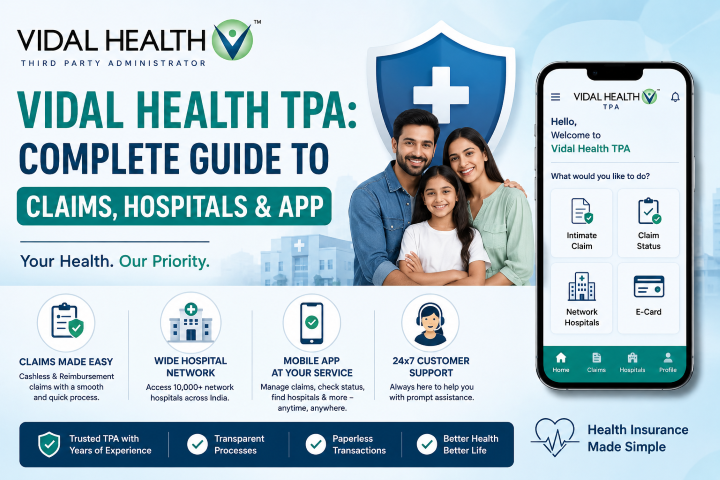
If you’ve ever had a health insurance policy through your employer in India, chances are you’ve come across the name “Vidal Health” on your insurance card without fully understanding what it does. Is it an insurance company? A hospital network? A wellness app? The confusion is common, and it’s exactly why so many policyholders end up stressed during a hospital admission, unsure of who to call or what documents to carry.
This guide breaks down everything about Vidal Health — what it is, how it works, how to use its cashless and reimbursement claim processes, how to find network hospitals, how the Vidal Health app functions, and what to do if something goes wrong along the way.
What Is Vidal Health?
Vidal Health is one of India’s largest Third-Party Administrators (TPAs) in the health insurance space. Established in 2002 and headquartered in Bangalore, the company has grown into a major player in India’s InsurTech and HealthTech ecosystem. It is licensed by the Insurance Regulatory and Development Authority of India (IRDAI), and it works on behalf of more than 20 insurance companies, including well-known names like HDFC Ergo, ICICI Lombard, and Niva Bupa.
Over the years, Vidal Health has expanded its footprint considerably. It merged with Vipul MedCorp Insurance TPA at one point, consolidating its position as one of the largest TPA networks in the country. In 2024, Vidal Health became part of the Bajaj Finserv Health group, a move that has since accelerated its digital transformation, expanding customer support channels and improving the technology behind claim processing.
Today, Vidal Health administers health coverage for a global book of tens of millions of lives, supported by a network that includes doctors and techno-functional resources across multiple countries. While it is headquartered in India, it also maintains offices in Dubai and Qatar, serving international insurers and healthcare providers through its global arm.
Vidal Health Is Not an Insurance Company
This is the single most important thing to understand about Vidal Health: it does not sell insurance policies, and it does not decide what your policy covers. That decision always rests with your insurer. Vidal Health’s role is purely administrative — it acts as the bridge between you (the policyholder), the hospital, and your insurance company.
Think of it this way: your insurer is the one who underwrites the risk and pays out claims, but Vidal Health is the operational engine that processes the paperwork, verifies your coverage, communicates with the hospital, and coordinates the settlement so that you don’t have to deal with each of these steps yourself.
What Does a TPA Actually Do?
A Third-Party Administrator sits between three parties in the health insurance ecosystem:
- The Insurer — the company that issues the policy and ultimately decides what is payable.
- The Hospital — the healthcare provider delivering treatment.
- The Policyholder — you, or your family member, receiving treatment.
Vidal Health’s job is to make sure these three parties are in sync. When you’re admitted to a hospital, Vidal Health verifies your policy details, checks whether the treatment is covered, communicates approvals or rejections to the hospital, and — once treatment is complete — settles the bill directly with the hospital on behalf of the insurer (in the case of cashless claims), or reimburses you directly (in the case of reimbursement claims).
For corporate and group health insurance policies especially, this administrative layer is critical. Large companies often have thousands of employees spread across cities, and a TPA like Vidal Health provides the infrastructure needed to manage claims at that scale without every employee having to navigate the insurer’s internal processes directly.
Vidal Health’s Scale and Network
Vidal Health’s scale is one of the reasons it has become a household name (even if people don’t always recognize the name itself) across corporate health insurance in India. Some key numbers that illustrate its size:
- 12,000+ network hospitals across more than 800 cities in India, with some sources citing figures as high as 15,000+ empaneled hospitals following network expansions.
- 35 million+ members covered through group and corporate policies.
- Approximately 1 million claims processed annually.
- 40+ offices spread across 28 Indian states, ensuring a local presence for policyholders who need in-person assistance.
- 20+ insurance partners, spanning both public and private insurers.
- A 24/7 helpline and dedicated corporate help desk for policyholders and HR teams managing group policies.
This extensive network is precisely why so many employers choose Vidal Health as their TPA partner — it gives employees a much higher chance of finding a cashless-enabled hospital nearby, no matter where they live or travel within India.
How Cashless Claims Work With Vidal Health
Cashless claims are the most commonly used — and most misunderstood — feature of any TPA relationship. Here’s how the process typically unfolds when you need cashless treatment at a Vidal Health network hospital.
Step 1: Choose a Network Hospital
Cashless treatment is only available at hospitals that are part of Vidal Health’s empaneled network. Before an elective procedure, it’s worth checking the network hospital list on Vidal Health’s website or through your insurer’s portal to confirm the hospital you’re considering is included. In an emergency, you may not have this luxury, but most major hospitals in urban India are part of large TPA networks like Vidal Health’s.
Step 2: Identify Yourself at the Hospital
At the hospital’s insurance or TPA desk, show your Vidal Health e-card (or physical TPA ID card) along with a valid photo ID — Aadhaar, PAN, or another government-issued identity document. This step is essential because the hospital needs to confirm you are indeed the policyholder or a covered dependent before initiating any paperwork.
Step 3: Fill Out the Pre-Authorization Form
This is the crux of the cashless process. The pre-authorization form usually has two parts:
- Part 1, filled out by you or your family member, covering personal and policy details.
- Part 2, filled out by the treating doctor and hospital staff, covering the medical diagnosis, proposed treatment, and estimated cost.
For planned hospitalizations, this form should ideally be submitted at least 48 hours (some sources cite up to 4 days) before the date of admission. For emergency hospitalizations, the hospital can admit you immediately and submit the pre-authorization request within a shorter window — often within 6 hours of admission.
Step 4: Vidal Health Reviews and Responds
Once the hospital submits the pre-authorization request, Vidal Health’s team reviews the case: verifying the policy is active, checking sum insured availability, confirming the treatment falls within policy terms, and assessing whether any waiting periods or exclusions apply. Vidal Health then issues either an approval or a rejection, typically communicated to the hospital within a few hours, though more complex cases can take longer.
If approved, an authorization letter specifying the approved amount is sent to the hospital. If Vidal Health has queries about the case (a “query” or “shortfall” in TPA terminology), it may request additional information before finalizing the decision.
Step 5: Treatment and Discharge
If your cashless request is approved, you receive treatment without having to pay the hospital upfront for covered expenses. Before discharge, the hospital sends the final bill — with a full breakup — along with the discharge summary to Vidal Health. Vidal Health then processes the final enhancement (if needed) after deducting any non-medical expenses that are not covered under the policy, and sends final approval to the hospital.
You’ll be asked to sign the final bill and claim form before leaving. Any non-covered expenses — such as certain consumables, co-payment amounts (if your policy includes a co-pay clause), or items outside policy terms — will need to be paid directly by you at the hospital.
What If Cashless Is Rejected?
A rejection of cashless approval does not mean your treatment will be denied or delayed at the hospital — treatment continues regardless. What it means is that you’ll need to pay the hospital bill upfront and then apply for reimbursement separately. This is an important distinction many policyholders don’t realize in the moment: a cashless denial is a payment-mechanism issue, not a medical-necessity refusal by the hospital.
How Reimbursement Claims Work
If you receive treatment at a non-network hospital, or if your cashless request is rejected, you’ll need to go through the reimbursement route instead. Here’s the general process:
- Pay the hospital bill yourself at the time of treatment and discharge.
- Intimate Vidal Health about the hospitalization — ideally within 7 days of admission, though the exact window can vary depending on your specific insurer’s terms.
- Download and fill out the claim form (often referred to as Claim Form No. 9) from Vidal Health’s website or a branch office.
- Gather all required original documents (detailed list below).
- Submit the completed form and documents to your nearest Vidal Health branch office, either by courier, post, or in person.
- Wait for claim processing. Once Vidal Health receives your documents, the claim is typically processed within 15 working days, assuming no additional documentation is required.
- Receive reimbursement directly into your registered bank account, generally within 7–10 working days after approval, though this can vary.
Documents Typically Required for Reimbursement
Reimbursement claims require a fairly comprehensive documentation package. While exact requirements can vary slightly by insurer, the standard checklist includes:
- Duly signed claim form
- Photocopy of your Vidal Health TPA card
- Photocopy of identity proof
- Discharge summary with hospital seal and doctor’s signature
- Original in-patient bills
- Doctor’s prescriptions
- Pharmacy bills with itemized breakups
- Investigation reports (MRI, CT scan, X-ray, ECG, etc.)
- Laboratory reports
- Paid receipts bearing the hospital’s seal and signature
- Hospital registration copy (if requested)
For maternity-related claims specifically, additional documentation such as obstetric history (number of live children) mentioned in the discharge summary may be required.
If any of these documents are missing, Vidal Health will raise what’s called a “shortfall query,” and you’ll typically be given 5–7 working days to submit the missing paperwork. Claims that don’t meet the required parameters — due to excluded treatments, exceeded sub-limits, or incomplete documentation — may be rejected, so it’s worth double-checking your document set before submission.
Finding Vidal Health Network Hospitals
Because cashless treatment is restricted to empaneled hospitals, knowing how to check the network hospital list before a planned procedure can save significant time and stress. Vidal Health maintains a searchable hospital list on its website, filterable by city, which is the most reliable way to confirm whether a specific hospital is currently part of the network — network status can occasionally change, so it’s worth checking close to your admission date rather than relying on older information.
Some hospitals fall under special tariff categories such as Preferred Provider Network (PPN) or GIPSA-empaneled hospitals, which apply pre-negotiated rates for cashless treatment. If your treatment happens at one of these hospitals, your final approval amount will be based on that specific tariff structure rather than the hospital’s standard billing rates.
The Vidal Health Mobile App
Alongside its administrative and claims infrastructure, Vidal Health also offers a consumer-facing mobile app (available on both Android and iOS) that combines insurance-related tools with telemedicine features. The app allows policyholders to:
- Book appointments with doctors or hospitals directly through the app
- Access online medical consultations via chat, voice, or video call across specialties including cardiology, gynecology, dermatology, pediatrics, psychiatry, endocrinology, and more
- View and download their e-card or TPA ID card
- Track claim status
- Manage healthcare needs for multiple family members from a single account
- Receive appointment reminders and follow-up notifications
The app markets itself around convenience — letting users avoid long waits at physical hospital desks by handling appointment booking and consultations digitally. That said, user reviews on both the Play Store and App Store are mixed. While some reviewers highlight fast claim turnarounds and improved service after early technical issues were resolved, others have reported frustrations, including delays with escalation processes and inconsistent responsiveness from support lines for issues like diagnostic sample collection. As with most large-scale service platforms, experiences can vary depending on the specific hospital, city, and insurer combination involved.
How to Check Your Vidal Health Claim Status
If you want to track a claim without calling the helpline, Vidal Health offers a self-service employee portal. The general process is:
- Visit the Vidal Health TPA employee portal.
- Enter one of the following identifiers: your enrollment ID, pre-authorization number, claim number, registered mobile number, or email ID.
- View your current claim status, including whether it’s under review, approved, rejected, or pending additional documents.
Claim status can also typically be tracked through the mobile app, and Vidal Health has expanded its communication channels to include SMS and email alerts whenever there’s an update on a pre-authorization or claim request, so you don’t need to constantly check manually.
Vidal Health vs. Your Insurer: Key Distinctions
Because Vidal Health interacts with you far more directly than your actual insurer does during a hospitalization, it’s easy to conflate the two. But a few distinctions matter:
- Your insurer decides coverage. Vidal Health administers the process, but final decisions on what’s payable under your policy rest with the insurance company.
- Vidal Health is not a credit facility. The TPA card is not a payment instrument; it simply verifies your coverage so that cashless treatment can be authorized where eligible.
- Your policy document is the source of truth. If there’s ever a dispute about what should or shouldn’t be covered, your policy schedule (issued by your insurer) governs the outcome — not any verbal assurance from a TPA representative.
- The TPA name is usually printed on your health card, alongside your insurer’s name, so you can verify which TPA is managing your specific policy.
Common Pain Points and How to Avoid Them
No large-scale claims administration system is without friction, and Vidal Health is no exception. Based on common feedback from policyholders, a few recurring pain points are worth knowing about in advance:
Delayed sample collection or service scheduling: Some users have reported issues with diagnostic services booked through the app not being fulfilled on time, along with difficulty reaching escalation contacts. If you experience this, it helps to document timestamps and reference numbers immediately so you have a clear record if you need to escalate through your employer’s HR or benefits team.
Documentation shortfalls: A significant share of reimbursement claim delays trace back to incomplete paperwork — a missing itemized pharmacy bill, an unsigned discharge summary, or a missing lab report. Before submitting any reimbursement claim, cross-check your document set against the standard checklist above.
Confusion between rejection and denial of treatment: As covered earlier, a cashless rejection is not the same as a denial of treatment. Hospitals are expected to continue care regardless of cashless approval status, with the policyholder paying and later filing for reimbursement if needed.
Not confirming network status in advance: For planned procedures, always verify current network hospital status shortly before your admission date rather than relying on an older printed list, since empanelment can change.
Why Employers Choose Vidal Health for Group Health Insurance
From an employer’s perspective, a handful of factors make Vidal Health an attractive TPA partner for corporate group health policies:
- Network breadth — a hospital network spanning thousands of facilities across hundreds of cities reduces the odds that an employee in a smaller city will be stuck without cashless access.
- 24/7 support infrastructure — a round-the-clock helpline and dedicated corporate help desk reduce the burden on internal HR teams fielding claim-related questions.
- Digital-first tools — the combination of a mobile app, employee self-service portal, and automated SMS/email alerts reduces manual back-and-forth.
- Scale and experience — with two decades of operation and a large existing base of insurer relationships, Vidal Health has institutional experience handling high claim volumes efficiently.
- Backing by Bajaj Finserv Health — the 2024 acquisition brought additional resources and digital investment, which has translated into ongoing platform improvements.
Frequently Asked Questions
Is Vidal Health an insurance company? No. Vidal Health is a Third-Party Administrator (TPA), not an insurer. It processes and coordinates claims on behalf of insurance companies but does not underwrite policies or make final coverage decisions.
How do I know if Vidal Health is my TPA? Check your health insurance policy schedule or physical/digital health card — the TPA name is usually printed alongside your insurer’s name.
How long does cashless approval take? It varies by case complexity, but approvals (or rejections) are typically communicated to the hospital within a few hours of a complete pre-authorization request being submitted.
How long does reimbursement take? Once Vidal Health receives a complete set of documents, claims are typically processed within about 15 working days, with reimbursement to your bank account following shortly after approval.
What happens if my cashless request is denied? Treatment continues at the hospital regardless. You pay the bill upfront and can then file for reimbursement using the standard document checklist.
Can I use Vidal Health’s network at a non-network hospital? Cashless treatment only applies at empaneled network hospitals. At a non-network hospital, you’ll need to pay first and claim reimbursement afterward.
Is co-payment covered by Vidal Health? No. If your policy includes a co-payment clause, that portion remains your responsibility regardless of TPA involvement — Vidal Health facilitates claims but doesn’t waive policy terms set by your insurer.
Final Thoughts
Vidal Health plays a quiet but essential role in India’s health insurance ecosystem — one that most policyholders only think about during a stressful hospital visit. Understanding its role as an administrator rather than an insurer, knowing the difference between cashless and reimbursement processes, and keeping the right documentation ready in advance can make a real difference in how smoothly a hospitalization claim goes.
With its extensive hospital network, growing digital infrastructure under Bajaj Finserv Health, and dedicated support channels, Vidal Health remains one of the most widely used TPAs for corporate and individual health insurance in India. As with any large administrative system, experiences can vary — but being informed about how the process works is the single best way to make sure you get the coverage you’re entitled to, without unnecessary delays.